Twohundred and Seventy-Third Asic- A World of Language Learning Starts in Your Computer

Londonbild 1_OLÅ

I’d like to share with you how learning can become interesting to young students if focus on learning derives from questions raised by the students rather than the teacher. I was teaching a mixed group of students in grade four and five in the Swedish compulsory school system. The students all had very few contacts with native speakers of English or with students from other countries. I wanted them to improve both their written an oral English and thought of different ways. It was in the middle of the annual summer vacation and as usual I spent time thinking of the coming school year. Isn’t that typical for a teacher? I know I’m not the only teacher who spends time planning for future teaching while their off of school.

Anyway, I thought of the idea of getting some kind of pen-pal for each and every one of my students. At this time I had just got my first personal computer through work and I wasn’t very familiar with how to use internet as a resource. I was therefore searching for different websites in order to find addresses to PEN-pals. It wasn’t until I came across the website http://www.epals.com with the very new word #epals, that I realized that PEN-pals were completely outdated! I was thinking like a dinosaur! Briefly, ePals is a website where teachers or students or for that matter teachers AND students can get in touch with each other in order to collaborate in different projects. It doesn’t have to be international projects, but in my case it was.

From the start I didn’t plan to collaborate at all with any American teachers. I was focused on the UK, since I was going to the UK in September in 2000. I spent a couple of hours reading different profiles in the ePals website and then I wrote my own profile. Already while I was browsing the site, I got a few mails in my inbox. There were two of them from American teachers and one of them was from a British teacher. They all seemed very nice, but since I was in a hurry to get my project going, I wrote to the British teacher, telling him about my plans to go to the UK and I also fired off my question about the two of us meeting each other to plan our future collaboration with our students. I wrote “Since I come to the UK in September, I hope we can meet and plan for our mutual project!” Then, since I was in a hurry and also because I know that teachers don’t like to spend time doing the wrong things, I wrote back to the two other teachers politely telling them that unfortunately I had already found a teacher in Britain whom I wanted to collaborate with and thus I didn’t need to write to them…

The “British” teacher replied to my email saying something like “It’s not that I don’t WANT to meet you, but how exactly did you think we could meet if you go to the UK and I live in New Jersey?”
Anyone who gets an email with that comment could have given up, but I’m not that kind of person. I wrote back. The “British” teacher wasn’t at all British and the REAL British teacher, whom I mistaken for being American, was of course already lost and gone, so what options did I have??? I started off brushing up my own English, by writing back and forth to this particular American teacher, who seemed to be a nice person already from the start. He was a teacher in a class in the same age span as my students, so after a few weeks of planning we started off writing emails between the two different schools.

At first, we instructed our own classes to write more general letters about themselves and share photos and details about the school system or what the school looked like. But gradually as the students got to know each other a little better, they started to ask their own questions and compared the learning situations in Sweden and New Jersey. My students, who were used to several breaks during school days, were shocked to notice that the students in the American school had fewer breaks and also lacked a nice lawn and a playing-ground at school. Outside the American school was instead a parking lot.

There were a lot of similar topics that gave students in both ends of our mutual collaboration a chance to challenge their language skills. In the American end students had a more cultural based viewpoint to our project, whereas in Sweden the focus was mainly on language and how to express oneself. One thing lead to another and the American teacher and I also visited each other’s schools and got the opportunity to see through teaching what it was like to teach in a completely different school setting than the one we were used to, respectively. I remember from MY teaching during one single day in the American school, that it was weird to be addressed Mrs Olenius. I also found it interesting to interact with the student in MY way, rather outspoken and joking, and notice how a few of the American TEACHERS frowned. It seemed to me as if they were taking their ROLE as teachers much more seriously than I do, which was interesting to note.

Later, my American friend visited me and my class in Sweden. He had brought with him a few interesting lessons to teach and one of them was in Physics, where he wanted to show the students how an American Hurricane builds up, by using two large bottles that he quickly moved in order to make it seem like a hurricane inside the bottles. An interesting thing with his experiment is the obvious difference between the ways we would do such an experiment and the way he did. He ended up getting eager students around him who wanted to do the experiment themselves, not just look at him doing it. In Sweden I’d say most teachers would give their students the opportunity to try out such an experiment by themselves. Another thing the American teacher probably noticed is that his usual reference to the famous Wizard of Oz didn’t work in Sweden. Why not?

A Swedish student in grade five generally wouldn’t know what kind of movie that is.
I’m happy to say that this American teacher and I have been friends for a long time now and thanks to him, I have learnt a lot about America that is more positive than I could ever imagine. Maybe it was meant to be that I mixed the American teacher with the British?

Vemvet

Two Hundred and Seventy-First Asic- If you give a Magpie a Cookie…

Mouse

Years ago when my oldest daughter was a couple of years old, she got this little book as a gift from one of my dearest friends in the USA. I was told by him that the story was very much appreciated by young children and along with the book my daughter also got a little stuffed animal in the shape of a mouse, dressed like the mouse on the cover of the book. The book is the kind of repeating story that children love to listen to and there are many other books similar to this in many other countries, for instance in Sweden where I live. We learn to love the stories, although adults tend to love the first few times we read them, while children seem to like them although it may be the hundredth time its read to them…

I was thinking of this book today, because the story about the little mouse who is likely to want more and more from the boy in the book, is acting like the magpie in my garden. I was sitting in my garden today, together with one of my friends. It was lovely weather and we enjoyed the sunshine after a days work. We were first right under the oak tree, but after a while when the sun was moving, we moved, too, since our bench was now in the shade. We left the set table with cookies and tea under the oak tree…but moved the bench to a spot where the sun was still warming.  Suddenly my friend said: ”Look! The magpie is stealing something from the table!”

To her surprise I was merely saying ”Oh!” in the same kind of voice we use for cute little animals we love, or for little children… I had to tell her that this was most likely ”my” magpie from the birds nest in my apple tree on the other side of our house… And my friend looked as if the next thing to say would be ”So?!” It turned out that we had different experiences from magpies and their behavior, but shared the point of view that they are pretty smart. I decided to give the magpie a cookie. But I didn’t act at once. Instead we chatted on and after a while the magpie returned for another try at the table… My friend commented that maybe It would be TOO much of an offer to give the magpie ALL my cookies, so then I clapped my hands and the magpie flew off again… After it was gone, I removed every cookie except one. I left it on the chair and my friend and I got back to our bench a few meters away to wait and see whether the magpie would dare to try and get the cookie… She did!
drömmarMy only disappointment was that the magpie flew off to a garden two houses off from mine…

Really?! I couldn’t believe I was feeding the wrong magpie!!!…and with freshly baked cookies, too!!

Now I only dread the rest of the story, because if you give a magpie a cookie, she will most certainly come back for a glass of milk…but when I give her the milk, she will ask for a straw…

More about my magpie experiences are found in this link:

http://wp.me/p4uFqc-1e

magpie #skata

Twohundred and Sixty-Fifth Asic- Fifteen Thousand Views

wordle_OLÅ_4

Today this blog reached 15,000 views!

Thanks for reading! 

Two Hundred and Sixty-Forth Asic- School Smart with Smart Phones?

A lot of facts can nowadays be easily found on the internet. Rote learning as it was when I went to school, will soon be forgotten and a five-year-old can google just about anything with no help from an adult. I sometimes feel old when I notice how my kids know things I spent a lot of time learning. I do however think that the young generation of today are lucky to be able to browse all these facts and photos and movies and easily finding out about things that took a very long time when I was a child. They can even find friends abroad and getting to know a person on the other side of an ocean, speaking with that person in real time through computers and smart phones and I can’t help remembering my pen-pals in other countries and how I used to wait for days and weeks for their letters back to me… 🙂

All the kids nowadays need to do is Google… At work I notice that the gap between those who know how to handle IT and those who do not is increasing. There will be no equality unless students get their computers thru school and also good instruction from skilled teachers. There will always be students with parents who either cannot afford a new computer, or maybe don’t understand to what extent their kid will be left out in school if they cannot be online and use internet as the rest of the kids. Being curious is a good start!

Even if we may think some things were better THEN than they are NOW, we need to at least try to go with the flow…

Otherwise we, the teachers, would soon be relics, too… Stored and filed side by side with flanellografs,

chalkboards and sandpits with sticks…

griffeltavla.jpg (637×510)

In subjects where a smartphone is a rich resource I don’t fully understand why schools still say students cannot use their phones in class, but I assume it’s a matter of students’ age. The teacher has a great opportunity getting things done a lot more easy by accepting the use of smart phones when it IS smart to use them. If I would stick to the rules of many classrooms today and say ”Don’t use your smart phone in class!” my students would have a tougher time learning Swedish. I do however need to stress that one of the reasons for smart phones to be a good alternative in my classroom is the fact that I teach adults. My subject is Swedish as a Second Language.

I have experience from working with teenagers or younger and having to address several situations each day where students have passed rules for the usage of their smart phones. Not all students respect rules and when students end up in recordings or photos that are posted on the internet that is a problem that takes a lot of important time off from the learning process in class. One way of dealing with problems such as that, is to remove the actual smart phone from the classroom situation. In many Swedish schools teachers collect the students’ phones before each lesson, in order for students not to use them in class. Thus the students are more focused on what their teachers say and what the lesson is all about, which is of course very important. I do however think that it is sad that such an extraordinary tool as the smart phone cannot be effectively used for learning purposes. If it’s a matter of disciplin, then the actual disciplin problem needs to be addressed. From here and on, this blog post is focusing on some of the benefits of using smart phones in learning situations.

Let me share a few examples from my own classroom, which is a language learning classroom with Swedish as a Second Language as the one and only subject. When we don’t find the solutions to meanings of words, the smart phones serve as dictionaries and saves a lot of time, compared to finding out by a visit at the local library, but that is not the only way to save time with a smart phone in a classroom! The students and I talk a lot about things we read, listen to or watch. I always try to help them by writing additional examples on my white board. This is however not a classroom with a SMART BOARD, but just an ordinary poorly equipped in-the-basement-classroom. When the white board is completely filled with comments, words and phrases connected to the topic we discuss,  I ask the students to simply use their smart phones and take a photo of my notes. That’s quick and easy and also a SMART way to use PHONES, although in the future,  I hope to be among the lucky ones who have smart boards in their classrooms.

Another thing with language learning is to use the phone for pronunciation. Many students in my classroom merely meet one person who speaks Swedish and I am that person. Although I try to give them several suggestions to where they can listen to Swedish, or perhaps meet Swedish people and talk to them, it is very difficult for some of them. Their smart phones is thus an excellent way to help them out with at least pronunciation of difficult words or phrases. More than anything else, the quality of the sounds of the nine Swedish vowels, when put in different positions of words or phrases are easy to repeat when students get back home, if they have recorded different examples in class. When students record my pronunciation and go back home and listen and repeat, their own pronunciation improves rapidly.

Ines Uusmann, Minister for Infrastructure, seemed to believe that the internet would be forgotten after a few years, although it is said that the reason why everyone remembers, is that the headline for the article was a fake quote. This is in fact (in Swedish, though…) what she said:

”Jag vågar inte ha någon alldeles bestämd uppfattning men jag tror inte att folk i längden kommer att vilja ägna så mycket tid, som det faktiskt tar, åt att surfa på nätet. […] Att sitta och surfa på nätet tar en himla massa tid. Vad är det bra för? […] Det kanske är så att det är något som vuxit upp nu. Alla pratar om internet men kanske är det övergående och sedan blir inriktningen mer specificerad”

Ines Uusmann citerad i Svenska Dagbladet, 12 maj 1996.

Källa: Rydén, Daniel, ”Dimmor på nätet”, Sydsvenskan, 4 mars 2007.


Twohundred and sixty-first asic- Let’s Make a Rock Carving!

Many years ago I went on an excursion in the village Nyberget, Stora Skedvi, where my mum grew up. We climbed a mountain just outside the village and the view was magnificent. The striking view was however not the purpose of this excursion, but instead we had all come to see for ourselves how young people from way back when had found a lot more important things to do on Midsummer’s Eve than to sing ”Små grodorna” and dance round the May Pole…

Lövåsberget med omnejd_Stora Skedvi

The lecturer, Stig Welinder, a well-known archeologist who at that time lived in the village, shared both details about many of the couples and facts found in the many church archives from the actual time. In Sweden it is possible to track our ancestors several hundred years back in time and this was also what the archeologist had done, in detail. He could tell stories of families with happy or sad moments in their lives, all facts verified and found in public archives where anyone could have found pretty much the same information if only we had spent that time. Many of the young couples in the local area had climbed this very mountain on Midsummer’s Eve to enjoy the sunset together.  To remember the day, they carved their names in the rocks on top of the mountain and also planned for a future life together. The place was well-known in the nearby villages as ”Skrivarhällen”(Welinder, 1992) and not just the teenagers from one of the villages climbed the mountain, but also those who lived on the other side of the mountain, a bit further away.

The rock carvings can still be found, if you first climb the mountain! 😀

Among other things that Welinder shared with us in his lecture, was the nature of names in Dalarna at the time when the rock carvings were made.  But there were just a few different names that seemed to be popular, and a few names were just the same, so in order to know who was who, you needed to add the name of the farm, or place, such as Petter Danielson, On the Hill. His son would be named after his father, Daniel Pettersson + On the Hill, and his son in turn, would most likely be called Petter Danielsson+ On the Hill… For women, the use of daughter would be used instead of son.

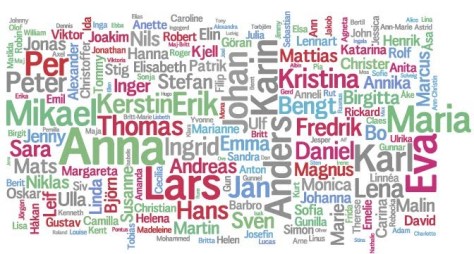
I would, for instance, have had the family name Dalkesdotter, since I am the daughter of Dalke. My brother would acoordingly have been called Dalkesson. During the 23 years I have been teaching I have noticed the change in naming. When I graduated in 1991, many of my first students had names that have been used in our country for generations. Boys names like Daniel, Peter, Mikael, Anders and girls names like Anna, Maria, Kristina, Helena, Ylva etc. But after a few years of teaching I noticed that many of the boys now rather had names like, Kevin, Justin, Jim, Tim, Tom and girls had names like Natalie, Felicia, Caroline, Nellie etc. Nowadays we find a lot of different names, a variation that can be connected to our complex world with input from not just the local area, but from other parts of the world.

namnbild.jpg (672×361)

My own name, Åsa, is from the time before Sweden was Christened and means ”goddess”. Very few little Åsa’s are to be found nowadays, but instead some of the names that I would connect to old relatives are coming up as new favourite names for kids. It’s funny how one sometimes hear parents call for their little ones and you expect a person in their seventies to approach behind a tree in the park, but instead a little toddler, called Bosse or Leif, will meet his Mom with a lovely smile!

toddlerRoundup-14.jpg (600×503)

My friend the archeologist from the mountain top is a very good example of being modern at the same time as he cherishes the value of how our ancestors chose to live their lives. What footprints or fingerprints will our generation leave? No mountains will be filled with names, but maybe we will share something else that is just as interesting and important? Let’s hope so!

Welinder, S (1992) on Skrivarhällen i southern Dalarna, Bergslagen, Sweden

Twohundred and fifty-seventh asic- A Swedish ”hen” is born!

The Swedish Royal Family is always in focus in one way or the other. This time for the reason of a little newborn, that we so far do not know much about. According to the press release a child is born… Not a girl or boy, but a child.

Swedish is a german language and generally we would use the pronouns he, she or it, to refer to anyone or anything, but a few years ago, a new pronoun was introduced, HEN, pronounced exactly as one would pronounce the feathered mother of a chicken…

HEN

For a few more minutes now, we still don’t know whether the new little ”hen” is a he or a she. What we DO know is how much attention Princess Sofia and Prince Carl Philip received by keeping the sex of the child a secret like this.

Tvåhundrafemtiofemte åseriet- Att jämföra

Att jämföra två objekt med varandra, innebär fler svårigheter än man kan tro, åtminstone för den som studerar ämnet svenska som andraspråk. Vilket språk vi använder när vi jämför kan vi till exempel läsa oss till i olika handböcker och även om handboksförfattaren har vinnlagt sig om att förklara systematiskt och noggrant, så kan det ändå vara så abstrakt formulerat att det leder till att eleven ändå inte förstår. Därför brukar jag försöka kombinera flera olika sätt att förklara, för att så många som möjligt ska kunna hitta sitt bästa sätt att förstå. Ofta hittar jag dessutom utgångspunkten till lektionen på något oväntat ställe. Den här gången var det ur Vi i villa, men lika ofta är det ur reklamblad eller i vanliga dagstidningar. Vi har så mycket språkbitar runt om oss som också behöver förklaring, att det verkligen inte är något problem att hitta utgångspunkter. Möjligen är det svårt att sovra…

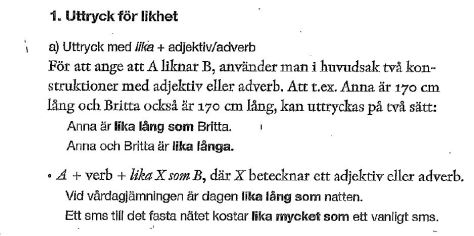
Dagens lektion om just jämförelse började därför med en genomgång av en handbokstext, som inte alls var speciellt lättbegriplig, men som i stället var noggrant systematisk. Exemplen i handboken var konkreta och tydliga och därför tipsade jag eleverna om att fokusera mest på exempelmeningarna utan att stirra sig blinda på de märkliga definitionerna som innehöll X och Y och närmast påminde om matematiska definitioner. Precis som jag misstänkt, fanns ändå i klassen några som tyckte att det matematiska upplägget var väldigt tydligt och bra, medan andra snarare värjde sig för själva definitionen, men utan problem förstod principen genom att studera exemplen. Från s 304 ur Garlén och Sundbergs Handbok i Svenska som andraspråk:

Ur Garlén och Sundberg_Handbok i Svenska som andraspråk

När vi något senare jobbat oss igenom handbokens beskrivningar av även skillnader, ville jag ge eleverna verktyg för att kunna jobba tillsammans med en jämförelse-övning senare. Därför ägnade jag mig åt att först hjälpa dem med ett antal ord och uttryck som de skulle behöva för övningen. Jag valde att utgå ifrån en sida ur tidningen Vi i villa (2014) som jag sparat just för att bilderna har så tydlig koppling till just temat jämförelse/likheter/skillnader. Jag ville först ge eleverna möjlighet att diskutera ”vilken bild de syftade på” och pratade därför med dem om raderna som första, andra och tredje raden, men förklarade även att man precis lika gärna skulle kunna säga ”på översta raden”, ”på den mellersta raden” eller ”på den nedersta raden”. Sedan pratade vi om andra liknande uttryck som också behövde komma upp till ytan just idag… till höger, till vänster, andra från höger, längst ut till vänster, i högra hörnet…i kanten…

Att jämföra

Sedan började vi prata om själva jämförelsen av grindarna på bilden… Jag bad eleverna föreställa sig att de skulle komma till byggmarknaden för att köpa en grind eller att de kanske arbetade där som säljare och skulle hantera den beskrivning en kund skulle ge av en specifik grind. Vilka typiska kännetecken har den enskilda grinden? Är den smal eller bred? Hög eller låg? är den enkel eller dubbel? Har den handtag och lås eller kanske enbart det ena? Är den enkelt utformad eller har den en rik ornamentik? Är materialet trä, stål eller smidesjärn? Finns det intressanta mönster som går att beskriva? Är den obehandlad, tryckimpregnerad eller är den vitmålad? När jag leker med den typen av övning i klassrummet, ger jag först alla ord man kan behöva, men sedan kollar jag snabbt hur mycket som fastnar, genom att be någon beskriva eller använda de helt nya uttrycken. Det handlar om det proximalt lärande (Vygotsky) och min erfarenhet är att det brukar ge tydligt och snabbt resultat och även eleverna själva känner att de lär sig nya ord och uttryck.

IMG_2030 (2)

Det jag redogjort för hittills är själva upplägget, undervisningen, innehållet… kalla det vad du vill. Efter detta är det snarare så att elevernas arbete återstår… De får en ANNAN uppgift att jobba med, men nu kan de använda sin ”ram” från den första tavelbilden här ovanför. De arbetar i par. Den ena i paret har ett A4-blad med femton bilder av personer, ordnade i tre rader, med fem i varje. Den andra personen i paret har en ”kortlek” med samma bilder, men i oordning. Personen med kortleken beskriver sitt första kort så pass noga att det går att hitta just den personen bland de femton bilderna på A4-bladet. Nu är det upp till kamraten att använda sina uttryck från min undervisning: ”Jag tror att du menar personen som är längst ner i vänstra hörnet” eller ”Jag tror att du menar personen som är på den andra bilden från höger på tredje raden” etc. Förutom att lärandet sker effektivt, så brukar elever tycka att det är ganska roligt också. Man fnissar åt varandras försök att beskriva eller bjuder på sig själv när man misslyckas med att förklara och i den där aktiviteten är man så pass ”här och nu” att lärandet sker av bara farten. Det är lätt att lära om man samtidigt har kul…

Den där första texten ur handboken då? Jo… När eleven kommer hem igen, med dagen i backspegeln, så går det lättare att förstå även den abstrakta svenskan och de märkliga formlerna, för nu har man tränat på något enklare, som går att förstå.

Tvåhundrafemtiofjärde åseriet- Imre Kertész, en författare som gjort skillnad!

Mannen utan öde_

Imre Kertész har i likhet med andra överlevande av Förintelsen under andra världskriget delat sin historia, antingen i fiktiv form eller genom otaliga föreläsningar och besök i skolor. Deras generation har snart gått ur tiden. Igår gick just Imre Kertész ur tiden. Jag skriver mitt blogginlägg för att vi inte ska glömma honom och hans författarskap. Hans texter har bidragit till vår kunskap om en tid som inte längre är. År 2002 tilldelades Imre Kertész Nobelpriset i litteratur med motiveringen:

”ett författarskap som hävdar den enskildes bräckliga erfarenhet mot historiens barbariska godtycke”

Läs den där motiveringen igen!

Den är kärnan i den enda bok av Imre Kertész som just jag har läst, nämligen Mannen utan öde. Jag läste den inte när Kertész just hade fått Nobelpriset, utan några år därefter, i samband med att jag lånade hem en bok som låg i bokförrådet på den gymnasieskola där jag då arbetade. Av baksidestexten framgick att boken hade delats ut som en gåva till alla gymnasielever i årskurs 3 år 2002. Den typen av information intresserar mig. Varför ska en hel årskull läsa en viss bok? Jag ville helt enkelt veta vad som var så speciellt med just denna skildring. Fakta och fiktion i kombination kompletterar varandra alldeles utmärkt för ökad förståelse, som jag ser det. Därför är en sådan sak som att dela ut en bok till gymnasieelever en god idé om man samtidigt tar sig tid att diskutera och förklara och skapa en bakgrundsbild till ett sådant viktigt område som Förintelsen. Jag har läst många olika skildringar av varierande kvalitet om just Förintelsen och även om andra världskriget i allmänhet. Därför tänkte jag om Imre Kertész bok när jag stod i materialrummet och höll den i handen,  att den var ”en i mängden”. I efterhand är det emellertid så att just den skildringen tydligt skiljer sig från mängden på en viktig punkt, nämligen just det som står i motiveringen till Nobelpriset här ovanför.

”Mannen utan öde” är skriven som om den är självbiografisk, men enligt uppgift i olika artiklar, bland annat av Göran Sommardal (Aftonbladet 160331), är det inte en självbiografi, utan en fiktiv berättelse som i hög grad liknar Kertész eget öde. Boken handlar om en fjortonårig pojke i Budapest, som år 1944 inte får åka med bussen, utan måste gå av, utan vidare förklaring. Redan där har vi egentligen ett exempel på ”historiens barbariska godtycke” som Nobelprismotiveringen antyder… Pojken förstår först inte alls, men sedan inser han åtminstone när bussen försvunnit i fjärran att han inte är ensam om sitt öde. I likhet med andra judar har han tvingats avbryta sin resa och ut från buss efter buss, kommer många andra som likt honom inte heller förstår allvaret. Från den stunden är allt i stort sett obegripligt för pojken, men jag som läser texten kan känna igen det pojken upplever från otaliga faktaskildringar jag läst i olika källor. Den stora skillnaden mellan att läsa torra fakta, jämfört med att läsa fiktion i form av en nära-nog-självupplevd skildring av samma tidsperiod,  är att fiktionen ger en annan bild, betydligt rikare och mer mångfacetterad än de kortfattade komplexa meningar som man återfinner i en historiebok om andra världskriget. Att förstå en tidsperiod från olika perspektiv, med hjälp av de många olika röster som var med på den tiden, möjliggör för mig att identifiera mig med dem som levde då, som var med och såg med sina egna ögon.

Trots att Mannen utan öde likt alla de alla skildringarna utlovar ett inifrånperspektiv från förintelselägren under andra världskriget, så är det inte det som i första hand gör boken läsvärd. I mitt tycke är det snarare den litterära gestaltning som författaren ger den fjortonårige huvudpersonen. Han är verkligen helt ovetande om vad som väntar honom och hans gradvisa uppvaknande är vad som gör boken så speciell. Skildringen innehåller väldigt många motbjudande detaljer och fasansfulla upplevelser, men väldigt lite av pekpinnar och snusförnuftiga kommentarer. Den är inte heller sentimental, utan rak i kommunikationen. Den skildrar hela tiden pojken och hans perspektiv på ett sätt som skapar en insikt på djupet hos läsaren. Därför förstår jag varför man skulle vilja dela ut just den till årskurs tre i gymnasieskolan. Man vill att också de ska drabbas av samma genomgripande insikt.

Björn Granaths inläsning av ”Mannen utan öde” av Imre Kertész


Twohundred and fortieth asic- Had The Beatles been the same without George Martin?

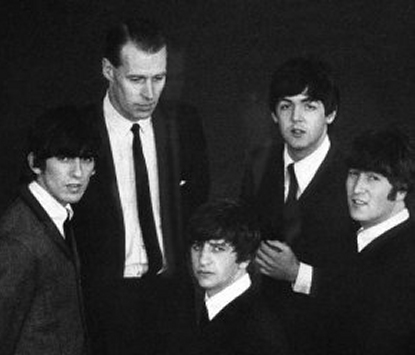
george martin_and_beatles_OLÅ

Generally speaking one might assume that producers make an impact far beyond their actual work on a daily basis… I think of famous producers like for instance Stikkan Andersson for ABBA or George Martin for the Beatles. When I heard the other day that George Martin had passed away, I simply thought that such a musician must have been a very important person for the Beatles although we all know that both John Lennon and Paul McCartney specifically are known for being just the same… I can’t help thinking that there might have been other things but musical arrangements that could have lead the Beatles in one direction or the other.

So many of the Beatles’ tunes are very different from all other current music. They were one of a kind and I’m sure you all agree… My listening starting the day when they reported on TV about the murder of John Lennon in NYC in 1980. I hadn’t even heard about the Beatles before that date. A few years earlier I had the same experience with Elvis Presley… I asked: ”who is he?” just like I did with John Lennon…

I started of a constant listening and a year or so later I had a pretty good idea of the music of the Beatles. I had also had a chance to sing-along in school, just like I guess many other youth at that time. My music teacher at school was a devoted Beatles fan who let us all sing the Beatles almost every music lesson… We also watched the movie ”Help!” and I found out more about Indian religion and all of a sudden I knew who Kali was… The very same way I learnt what the French national anthem sounded like…since that’s possible to hear in the end of All you need is love…

All you need is love

I think music is like that always… I learn completely different things but just the music when I listen to music. I also notice that we are all different… I remember when comparing with some of my friends who focused on the tune, the music, I would more likely focus on the lyrics… Having said that I can make a long list of really good Beatles lyrics that all make a difference for everyone who take the time to listen carefully. My music teacher not only shared his favorite tunes by Beatles, but also his knowledge packed in a youth-friendly way… one detail at the time… We listened to ”Julia” while learning that John Lennon’s mother was the motive for this song.

Yellow submarine

Yellow submarine

We listened to Yellow submarine and learnt the word submarine meant ”u-båt” in Swedish… Learning languages through music is such a smart thing to do, really… Every language learner knows that it may be very tricky to know what idioms to translate and use, and what idioms not to use because they don’t make sense in the other language, however sleeping like a log DID… In Swedish a line like ”Sleeping like a log” is ”sova som en stock”. By singing Beatles songs I had found a new and much more fun way of learning, than by reading boring school books… 🙂

Hey_Jude

Hey Jude… starts off in a very kind and cautious way, but musical instruments are added one on top of the other and finally a whole orchestra plays along with Paul McCartney… The chords and the lyrics, the choir and the way Paul uses his imagination to make variations of the tune, makes this song one of my absolut favorites. At the very end they sing their catchy ”da da da da, Hey Jude!” and you just have to join them…

But interestingly enough as time pass I digged deeper into the music of the Beatles. From just listening just to the most common tunes, such as ”She loves you”, ”Help” and a ”I want to hold your hand” I started to listen to other tunes, not that common. I also decided not just to listen to their ”Greatest hits” however at that time, music was more difficult to access than now. No spotify and no iTunes would be possible for us to use… Instead we had to buy the music on EP:s or LP:s and so I bought ”Abbey Road” since I had completely fallen in love with ”Here Comes the Sun”… It’s such a beautiful tune! I bought the LP for that very tune, just as we had to, back then, but being economically wise…I of course listened to all the other songs on that LP and found new favorites among the other tunes as well.

One of the surprising tunes is the 26 seconds long ”Her Majesty”, that is very interesting since it has a point, at least in my opinion… really, what DO we know about the Queen of England…?

Her Majesty

I think there are tunes we need to listen to over and over again, and yet others that we can follow easily right away. With most of the Beatles’ music, they are of the second kind. You don’t just learn the lyrics, but also the catchy melodies and their treasure of songs thus belongs to all of us. Arrangements are more important than one may think…  To conclude this blogpost I’d like to add my assumption that George Martin was one of the most important reasons why the Beatleas actually produced so much music of high quality. I think these young boys needed a person that weren’t just ”one of them” to tell them what to do and how… Am I wrong? Maybe, then so be it… but please allow me to send a thought to the memory of George Martin and thank him for what he did for my many joyful moments when consuming music by the Beatles.

One of the most lovely songs in my opinion, was , as I am told, a kind of answer to the huge impact of ”Bridge Over Troubled Water” by Paul Simon… The Beatles wanted to prove that they were still the best:

Let it Be

At Skavlan the other day, the famous pianist Lang Lang was asked to perform something by Beatles to honor George Martin. He played Blackbird. I enjoyed his version very much and thought about what impact the Beatles still have.

Two hundred and thirtyeighth asic- Kids vs Dinosaurs at Natural History Museum

Journey to the Centre of the Earth

Journey to the Center of the Earth, just like in Jules Verne’s book…

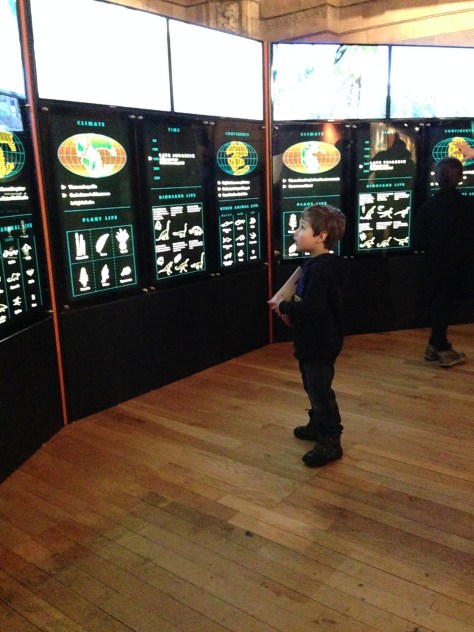
When entering the magnificant Natural History Museum in London, you virtually end up in the Center of the Earth… and when you reach the first floor you have a great opportunity to understand natural forces such as volcanoes and earthquakes and how rocks erode into pebbles and sand. When we walk through the many displays we comment on the fact that behind every single display hours and hours were spent in collecting facts, building suitable models by various materials, trying to explain to the visitors how things work… I think the very difficult topics in Natural History Museum were very well described and easily understood, both for adults and kids. That is a fantastic help for all the visiting teachers, since they can thus walk through the displays with their classes in a more relaxed way, trying to answer the many spontaneous questions they get from their students walking through . There were plenty of fantastic hands-on-displays and charts and maps of different kinds. A fantastic experience  for both teachers and students!

Oak leaves

Whatever adults think of dinosaurs, I know from my years of teaching young kids, that the long lost creatures are very popular for some reason. Why is that? I think one reason may be that they can be compared to the dragons we get to know through children’s stories and old fairy tales. Maybe kids also use their imagination more than we do and picture themselves walking around on earth at the same time as dinosaurs?

When visiting the Natural History Museum in London one thing that struck me was that it was crowded with kids…

Being a teacher off work among kids who learn is very interesting. I tend to follow closely behind trying to eavesdrop and also finding ways to see what they see…

Young audience at Natural History Museum

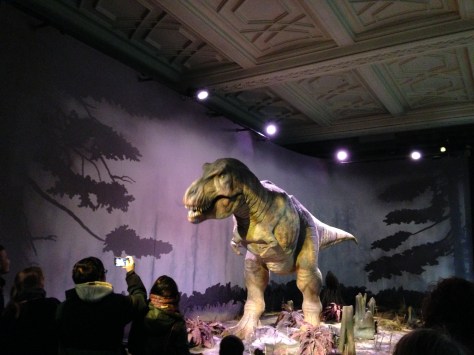
A dinosaur come's alive...

I remember twenty years ago when I taught an eight-year-old boy who told me all there was to know about dinosaurs. Despite his young age, he could hold a lecture about them, what they looked like, when they lived etc. I tried to keep up with him and borrowed books in the local library, but whatever I found there, was already known to him. I think books about dinosaurs may be the solution for some children’s reading problems… If they are eagerly trying to learn more about their favorite creatures, it may be more interesting for them to read an adapted fact book than to read anything else.

The very realistic looking dinosaurs at Natural History Museum serve the imagination and help many teachers, too, since they have a chance to explain very difficult things with the help of models and pictures and the many displays everywhere in the museum.

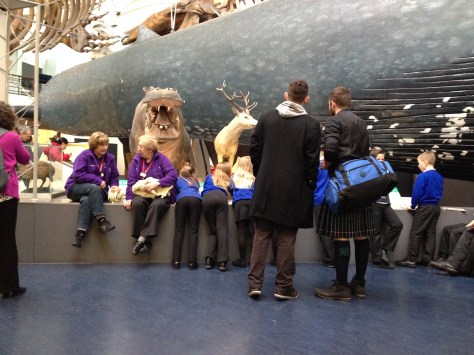
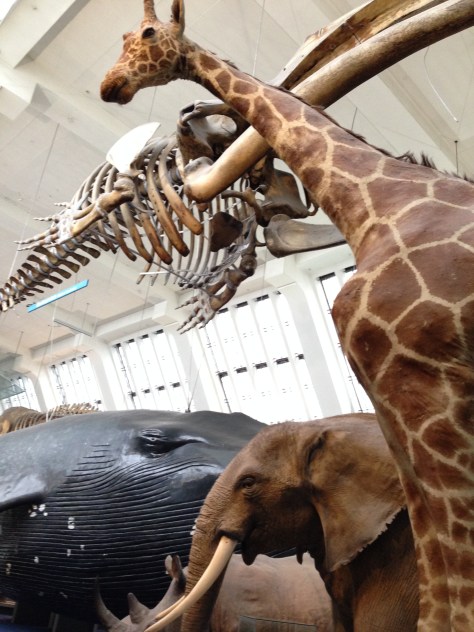
An area where we saw many students and teachers were where they kept the stuffed mammals.

A learning environment

A learning environment

Stuffed Mammals

Stuffed Mammals