Twohundred and sixty-first asic- Let’s Make a Rock Carving!

Many years ago I went on an excursion in the village Nyberget, Stora Skedvi, where my mum grew up. We climbed a mountain just outside the village and the view was magnificent. The striking view was however not the purpose of this excursion, but instead we had all come to see for ourselves how young people from way back when had found a lot more important things to do on Midsummer’s Eve than to sing ”Små grodorna” and dance round the May Pole…
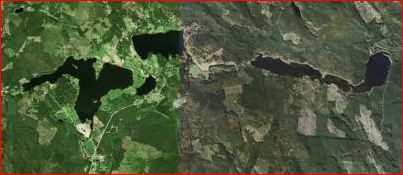
Lövåsberget med omnejd_Stora Skedvi

The lecturer, Stig Welinder, a well-known archeologist who at that time lived in the village, shared both details about many of the couples and facts found in the many church archives from the actual time. In Sweden it is possible to track our ancestors several hundred years back in time and this was also what the archeologist had done, in detail. He could tell stories of families with happy or sad moments in their lives, all facts verified and found in public archives where anyone could have found pretty much the same information if only we had spent that time. Many of the young couples in the local area had climbed this very mountain on Midsummer’s Eve to enjoy the sunset together.  To remember the day, they carved their names in the rocks on top of the mountain and also planned for a future life together. The place was well-known in the nearby villages as ”Skrivarhällen”(Welinder, 1992) and not just the teenagers from one of the villages climbed the mountain, but also those who lived on the other side of the mountain, a bit further away.

The rock carvings can still be found, if you first climb the mountain! 😀

Among other things that Welinder shared with us in his lecture, was the nature of names in Dalarna at the time when the rock carvings were made.  But there were just a few different names that seemed to be popular, and a few names were just the same, so in order to know who was who, you needed to add the name of the farm, or place, such as Petter Danielson, On the Hill. His son would be named after his father, Daniel Pettersson + On the Hill, and his son in turn, would most likely be called Petter Danielsson+ On the Hill… For women, the use of daughter would be used instead of son.

I would, for instance, have had the family name Dalkesdotter, since I am the daughter of Dalke. My brother would acoordingly have been called Dalkesson. During the 23 years I have been teaching I have noticed the change in naming. When I graduated in 1991, many of my first students had names that have been used in our country for generations. Boys names like Daniel, Peter, Mikael, Anders and girls names like Anna, Maria, Kristina, Helena, Ylva etc. But after a few years of teaching I noticed that many of the boys now rather had names like, Kevin, Justin, Jim, Tim, Tom and girls had names like Natalie, Felicia, Caroline, Nellie etc. Nowadays we find a lot of different names, a variation that can be connected to our complex world with input from not just the local area, but from other parts of the world.
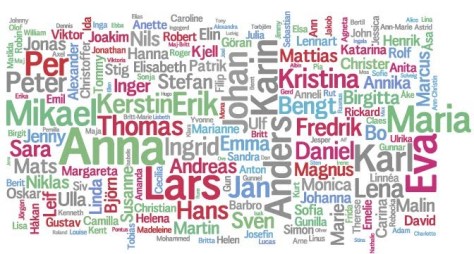
namnbild.jpg (672×361)

My own name, Åsa, is from the time before Sweden was Christened and means ”goddess”. Very few little Åsa’s are to be found nowadays, but instead some of the names that I would connect to old relatives are coming up as new favourite names for kids. It’s funny how one sometimes hear parents call for their little ones and you expect a person in their seventies to approach behind a tree in the park, but instead a little toddler, called Bosse or Leif, will meet his Mom with a lovely smile!

toddlerRoundup-14.jpg (600×503)

My friend the archeologist from the mountain top is a very good example of being modern at the same time as he cherishes the value of how our ancestors chose to live their lives. What footprints or fingerprints will our generation leave? No mountains will be filled with names, but maybe we will share something else that is just as interesting and important? Let’s hope so!

Welinder, S (1992) on Skrivarhällen i southern Dalarna, Bergslagen, Sweden

Two hundred and thirty-fourth Asic- Long walks in London

Taking a walk in the forest leaves a certain feeling, as do a walk in a city like London. Oh how many things there are to see! There are of course a lot of things we would like to do quickly and then we’d most likely choose to catch a bus or maybe go by underground from one end of the city to the other. I do however prefer the long walks in London since they offer an experience where you actually get to see more of the city. Walking through Hyde Park an early morning gives an idea of London in earlier days when British society was different from what it is today. I mean, who would arrange such a lovely park nowadays? We all seem captured in the rapid life of IT and reluctant to go out IRL.IMG_00221

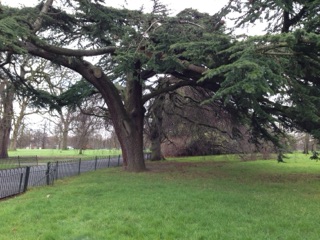
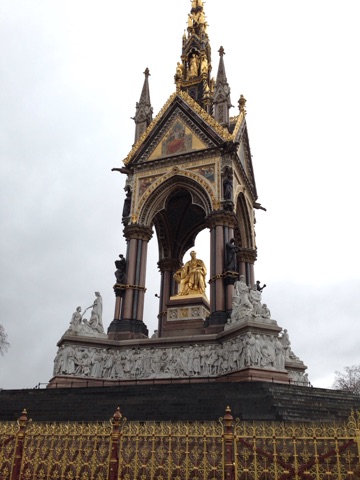
However taking that walk a very rainy day can be a true challenge. I bought a rain cap for my trip, knowing I might need to use it, but hoping for good luck with the London weather… träd 3Idegran i Hyde ParkI was however in a situation where the option was to end up soaking wet, or use the silly looking rain cap… so I used it…and I was happily dry after the rain… The walk past Albert Memorial on our way to Natural Science Museum and Victoria and Albert Museum was a nice stop, although the rain was pouring.


IMG_00231IMG_00241

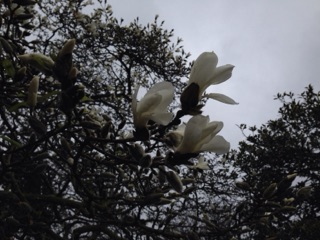
Hyde Park shows a variety of trees and bushes and trees in bloom. To come from the wintery Sweden and find magnolia in bloom is a great reward! I didn’t even mind the rain that moment!

Magnolia

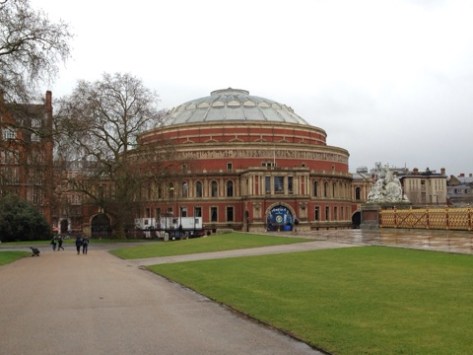
After spotting Albert Hall, we had just about ten minutes walk left until we could hide from the rain in Natural History Museum.

Albert Hall

The visit at the Museum was long enough for the rain to hold for a few minutes when we walked on to Victoria & Albert Museum. Both museums were interesting in many different ways and I guess I will need weeks to sort all my impressions from both visits. After a delicious lunch in Victoria & Albert Museum, we walked to Harrod’s to make sure the luxurious store was still standing… Honestly, after two Museums, a walk in the store and the rain…all together made my day and as early as seven o’clock we had our dinner and then returned to the hotel to relax. Walking is fun and you get to see a lot, but it’s also exhausting… I’ll share more pix here later when I get home and sort my photos properly.


One Hundred and Eightysecond Asic- ”The Last Witnesses:the Book of Unchildlike Stories” written by Svetlana Alexievich (1985)

The Last Witnesses: the Book of Unchildlike Stories written by the Belarusian Nobel Prize Winner of 2015, Svetlana Alexievich, tells another story than ”War Does Not Have a Woman’s Face”. This time Alexievich shows her excel by sharing hundreds of children’s memories from Belarus during the Second World War. I thought my reading ”War Does Not Have a Woman’s Face” would have prepared me for every surprising or somewhat appalling detail in The Last Witnesses: the Book of Unchildlike Stories but the fact is, I could not anticipate the way Alexievich had made the interviewed adults share so many exclusive moments from the past, filled with pain, horror and fear. Many of the children had been left behind by parents who either went to fight the enemy in the front army or in partisan groups and left their children with relatives. Many children were still in orphanages at the end of the war. Many parents never came back and their children still miss them:

”I’m already fifty-one, I am a mother myself, but I really do want a mother!” says one of the surviving children when interviewed by Alexievich.

What makes this book extraordinary is the way the author let short excerpts of longer interviews carry a few main topics that together form a war narrative we have never ever read before. The main topic is of course ”What happened in Belarus during the war?” however from a child’s point of view we rather see other topics, such as ”What happened to me when I lost my parents in the war?” or ”How could I survive although I didn’t have anything to eat except potato peels and grass?” and ”How could I survive and become an ordinary citizen after what I endured during the war?” What is even more interesting is that the reader is invited to read between the lines and make sense of all the narratives.

The Last Witnesses: the Book of Unchildlike Stories is close to the limit of what is bearable to read. One of the reasons why it gets under your skin might be that Alexievich has told the interviewed narrators to try and remember the way they thought when they were children. Obviously Alexievich succceeded since the narratives all seem to be told by children and not by adults remembering their childhood! From each narrator, Alexievich has found a central quote and the story is in a way interrupted by those quotes, changes topic quite often, but since the quotes are followed by the names of the narrator and their occupation as adults, the structure of the novel makes sense and the reader has a chance to a short glimpse of the adult reflection, too, since many of them end their narrative with a short comment about ”now”.

When reading the book, I think a lot of the many cups of tea that Alexievich must have had in the homes of the war veterans…and I also marvel about the way she has found something special in each narrative to tell us, however never repeating herself. Actually each narrator tells a completely unique story. They all share memories from the war from the point of view of a child, however the focus differ and thus a kind of quilt of stories takes form in my imagination. I read about personal loss, of fear, hunger, famine, children joining the army. I read about children who cannot go to school because they have to work in a factory or about children who don’t recognise their parents when they (if lucky enough!) meet them again after the war. But underneath the sad and depressing surface I also read about patriotism and pride, about never giving up and never revealing secrets to the enemy. The post war Belarus was completely destroyed and needed to be built up again and some of the narratives shared experiences from the postwar building up period when every survivor was needed, even the children.

But why would this book be necessary to read? The children suffered in so many different ways, but without the adult mind it was impossible for them to fully comprehend why there had to be a war. They needed to grow up in order to do so. We owe it to them to pass it on to next generation what a great loss they experienced when losing their parents, their childhood, their health and their innocence. Again, like when I wrote my previous book review: #This is a book that has to be read and spread!

Det hundrade åseriet/The hundredth åsic- A Moment 22 for many teachers

In 1992, I started off as a class teacher of twelve-year-olds in grade six. My exam covered Swedish, English and the four different subjects that are called ”SO” in Swedish, i.e, Geography, Social Science, History, and Religion. I was supposed to teach grades 1-7 in the Swedish Compulsory School System.  In 1992, it wasn’t unusual for teachers to teach both subjects they were skilled for as well as subjects where they didn’t have any exams. In my case my first job as a teacher was a position as a ”class teacher” with both Math, Science and Art. You may think:

”So what? If you have graduated, it doesn’t matter what subject you teach!”

I strongly object to that point of view. It DOES matter! First of all you need more time to prepare lessons properly in subjects where you have no academical skills or grades. Secondly you may not find suitable examples for students to understand complex structures or important details. Students who need extra attention from the teacher in order to ”get it”, would be better off with a skilled teacher in Math, rather than a teacher in Swedish, who tries her very best.

A Moment 22

The subjects you love most of all, will be neglected since you need to make an effort and focus on subjects you didn’t even want to teach in the first place. The estimated time for planning of lessons will be up when you start planning for your own favourite subjects.

An ordinary day when you have planned all for today’s lessons and come to school early enough to have a cup of coffee with your teaching friends, you notice that your dear friend in the classroom next to yours is on sick-leave. You hope for her (it’s often a she!) soon being back, but you also realize that you will be the one to fill her position in class, ALTHOUGH you have a classroom filled with students, too… What can you do about it? Not much, really. Hmmmm… 55 kids instead of 27? What is my options for today’s teaching…? As I said, I had planned it all from the start, right? But NOW, I will have to just dump my own plan, and also probably dump my teaching friend’s plan, because I am ONE teacher with TWO classes… I HOPE that is history by now!!!

I taught in a school where our policy was to be our own ”subteachers” in a flexible system. Quality??? Excuse me… We didn’t discuss that topic much. It was more about money. But why wasn’t it just possible to find a teacher who would be in our regular staff as an extra resource? Money… Again… OK… Then if there is no way to hire a TEACHER…can’t we just find SOMEONE????

For way too long it has been possible for principals in Swedish schools to hire ”teachers” who lack the required qualifications for teaching. Qualified teachers have also for way too long been responsible for ”helping” those subteachers in their job, instead of  teaching their own students with high quality. But why complain? It can’t be that difficult to help a friend who know nothing about teaching, right? No, not if it would be ONCE or maybe TWICE, but if it’s the rule rather than an exception, then it’s not fair at all. It is unfair to the students, both in my class and in the class where the subteacher works. We are all losing focus from our ongoing learning proccess.

A possible scenario

You rush into your own classroom, inform the students that  you will have to start a lesson together with a subteacher in the nextdoor classroom and will be back soon. Then you help the subteacher to find books or material, tell the students to help the subteacher as much as possible, also inform the subteacher about students with special needs, such as diabetes or epilepsy. You also try to write a short list of important details, such as at what hour you take a break, when students leave for PE, or when lunch is served. In some schools there is a binder filled with ”all a subteacher needs to know”, but despite the binder, many subteachers may either not have time to read the information, or are completely new to teaching and have never been in this particular school. Sometimes they are 18 years old and lack every experience there is to ask for. You help this person the best you can anyway, because you know it will turn out for the worse if you do nothing at all. Luckily, many subteachers have been teaching for a long time and also know the students in a few schools in their local community quite well. Then the options for a win-win-situation is a lot better. OK…It’s time to rush back to your own class and start off what you had planned for! Guess what? The students haven’t started doing what you asked them to… Instead you need to re-start the activity and sometimes you will have a hard time getting every student’s attention again. When you finally think, ”Yes!” and your class seems to be focused again, you hear a knock on your classroom door… The subteacher needs more help…

The results for Swedish school children in PISA and other international tests have never been as poor as the last few years. In my opinion it is possible to explain the failure as a misuse of resources and a slow motion in change or maybe blame the many changes in our school system. When will there be time to focus on learning again?

I am happy to say that I rarely hear about problems like these nowadays. I am also happy to say that some of the subteachers I have been teaching side-by-side with were really nice persons who did a wonderful job. A certain blonde whom I tried to persuade to become a teacher, instead decided to become a nurse. The lucky patients know who I mean! 

 sjukhus_91762714.jpg (380×230)

One hundred and thirtieth åsic- Winter break or Christmas Holiday?

I wonder what words we use now, compared to what we used to? Being a member of a Christian Society would mean that we remember Christmas as the Day when Jesus was born. But being a member of a secularised society means being careful with religious connections of any kind, at least when being a teacher. So… we might say Winter Break instead of Christmas Holiday… In Sweden I’d say most of us still say Christmas Holiday, ”jullov”, although not all of us would cherish the memory of Jesus. I suppose some children grow up innocently thinking that we celebrate Christmas because Santa comes…?

julklappar.jpg (450×447)

Easter… we celebrate Easter because we need an excuse to eat eggs and have fun searching for candy in an egg hunt? I noticed last spring that instead of calling our typical Easter flowers ”Easter lilies” they had a new more neutral name; ”Spring lilies” and I suspect the reason why was that they wanted to be able to sell those flowers to ANYONE, not just the people who celebrate Easter… How clever!!!

slider_minipasklilja.jpg (540×250)

Whatever we DO believe  in, we risk to forget the reason. If we don’t communicate with our kids and remind them of reasons for our traditions or holidays, then they will grow up not knowing. But, having said that, I still think respect is a beautiful word in our vocabulary. If I teach a group of students, I’m not supposed to promote any religion in particular. So how would I then share the Swedish way of celebrating Christmas, without hurting people who have another belief? How can I possibly not at all show my own belief? Do I need to be a non believing person in order to be trustworthy? I don’t think so. I think I need to communicate the official Swedish viewpoint at the same time as I can be true to myself by not negotiating with my own belief. SO… If I meet people of different beliefs at work, I tend to be the ”cushion” in between different viewpoints. I try very hard to tell my students that whatever you believe you are free to do so, since Sweden is a society where there is no longer a state religion. You can choose for yourself to believe or not and if you believe, it’s up to you whether you’re a Buddhist or a Moslem or if your God is Jahve. And when you neighbout has another belief than you do, then just leave your neighbour in peace. You, yourself, have the same opportunity to choose, don’t you? I think the very choice to decide for oneself, is one of the best laws here in Sweden.

person-facing-career-paths.jpg (364×238)

One hundred and twentysecond åsic- Imagine!


In 1980, I was only thirteen years old, when I heard a long row of John Lennon songs. The songs were all masterpieces and that made me listen. I wanted to know who sang… They played the Beatles, too, and after a while the many interviews accompanied the lovely music. In just a couple of days I discovered that there had been a singer/composer/writer called John Lennon AND that someone had put his life to an end. I have missed him, although I never knew him. I have enjoyed the many tunes he gave to the world and I wish for real, that his thoughts already had become truth. A month ago I commented on the Berlin Wall Memorial in my #ninetyninth åsic, by sharing the lyrics to Imagine. For all those who suffer in wars, worldwide, for all those who live in despair for a reason. Imagine!

 music-john-lennon-imagine-lyrics-colour-14160-23485_medium.jpg (676×474)

One hundred and twelfth åsic- Sunshine in November Makes Me Jump!

November has been going on for weeks, almost YEARS now…but today it happened! The sun managed its way through to us! It was noon and we could almost pretend that it wasn’t November…! I jumped!!! What a joyful moment! I’m not a dolphin, but just as happy!

Hoppande Delfin.jpg (300×203)

I was not in my classroom, although none of my students would have frowned for a sunshine jump, but in the staff room. My reward was a lovely laughter from the two of my teaching friends who were in the staff room at that time. They were, too, happy! We had all forgotten what the sun looked like and were SO happy for the unexpectedly bright sunshine for being this time of the year. I ofteb notice in my classroom, with students from all over the world, that November is a challenge, especially to those who are used to bright sunshine all year through.

tumblr_m1ke35A1kj1qacg79.jpg (500×327)

It is however not just sunshine that makes ME happy. I also look the stars in the sky for relaxing purposes and this time of the year I search the sky for Orion and think of a friend I know who will search the sky for Orion, too. Sharing a quiet moment wide apart is a way of connecting despite long distance.

orion_Large-e-mail-view.jpg (1024×1024)


One hundred and tenth åsic- School Smart with Smartphones

A lot of facts can nowadays be easily found on the internet. Many skills will soon be forgotten and a five-year-old can google just about anything with no help from an adult. I sometimes feel old when I notice how my kids know things I spent a lot of time learning. All they need to do is google. At work I notice that the gap between those who know how to handle IT and those who don’t is increasing. There will be no equality unless students get their computers thru school and also good instruction from skilled teachers. There will always be students with parents who either cannot afford a new computer, or maybe don’t understand to what extent their kid will be left out in school if they cannot be online and use internet as the rest of the kids. Being curious is a good start!

Even if we may think some things were better THEN than they are NOW, we need to at least try to go with the flow…

Otherwise we, the teachers, would soon be relics, too… Stored and filed side by side with flanellograms,

chalkboards and sandpits with sticks…

griffeltavla.jpg (637×510)

In subjects where a smartphone is a rich resource I don’t fully understand why schools still say students cannot use their phones in class. The teacher has a great opportunity getting things done a lot more easy by accepting the use of smartphones when it IS smart to use them. When we don’t find the solutions to meanings of words, the smartphones serve as dictionaries and saves a lot of time, compared to finding out by a visit at the local library, but that is not the only way to save time with a smartphone in a classroom!

Let me share a few examples from my own classroom, which is a language learning classroom with Swedish as a Second Language as the one and only subject. The students and I talk a lot about things we read, listen to or watch. I always try to help them by writing additional examples on my white board. This is however not a classroom with a SMARTBOARD, but just an ordinary poorly equipped in-the-basement-classroom. When the whiteboard is completely filled with comments, words and phrases connected to the topic we discuss I either take a photo myself and later I re-write some of the unreadable stuff for my students, OR I ask them to simply use their smartphones and take a photo of my notes. That’s quick and easy and also a SMART way to use PHONES.

Another thing with language learning is to use the phone for pronunciation. Many students in my classroom merely meet one person who speaks Swedish and I am that person. Although I try to give them several suggestions to where they can listen to Swedish, or perhaps meet Swedish people and talk to them, it is very difficult to some of them. Their smartphones is thus an excellent way to help them out at least with pronunciation of difficult words or phrases and also more than anything else, the quality of the sounds of the nine Swedish vowels, when put in different positions of words or phrases. When students record my pronunciation and go back home and listen, repeat, and their own pronunciation improves rapidly. So, if I would stick to the rules of many classrooms and say ”Don’t use your smartphone in class!” my students would have a tougher time learning Swedish.

Ines Uusmann, Minister for Infrastructure, seemed to believe that the internet would be forgotten after a few years, although it is said that the reason why everyone remembers, is that the headline for the article was a fake quote. This is in fact (in Swedish, though…) what she said:

”Jag vågar inte ha någon alldeles bestämd uppfattning men jag tror inte att folk i längden kommer att vilja ägna så mycket tid, som det faktiskt tar, åt att surfa på nätet. […] Att sitta och surfa på nätet tar en himla massa tid. Vad är det bra för? […] Det kanske är så att det är något som vuxit upp nu. Alla pratar om internet men kanske är det övergående och sedan blir inriktningen mer specificerad”

Ines Uusman citerad i Svenska Dagbladet, 12 maj 1996.

Källa: Rydén, Daniel, ”Dimmor på nätet”, Sydsvenskan, 4 mars 2007.

One hundred and fourth åsic- To choose or not to choose is the question

148948_63610672.jpg (475×356)

When I was in NJ a couple of weeks ago I noticed that I am not very good at choosing and find myself ambivalent and indecisive, If there are a lot of options. At least when it comes to choosing food from a menu… 😀

I wonder if I possibly have inherited this from my daughter? We are just the same when we are in a situation of choice. If we get stuck, we do however have different solutions to our problem. My daughter would most likely go for a choice similar to some of her friends, and thus avoid the risk of feeling her own choice was in any way bad. I, myself, on the other hand, sometimes want to follow the stream, not be the one to be a nuisance to others. SO although we both may do as others do, we seem to do so for completely different reasons. We also both tend to pick ”both” when it may be difficult to pick ”either…or”…

One of my friends have decided for herself to give herself a kind of punishment if she cannot make a decision when she is picking something for her (fika)coffee. If she cannot make up her mind about what nice pastry to choose, she simply says: ”En kanelbulle, tack!” (A cinnamon bun, please!). I remember many different situations when this friend and I have lined up to buy a cup of coffee and she and I both try hard to make a decision, but when it’s our turn at the check-out, we realize that it’s impossible… Luckily a cinnamon bun is a great treat along with a cup of coffee!

kanelbullar2_2352.jpg (3648×2736)

But…what if my reluctance to make a choice is the very reason why I find it so difficult to be decisive in my classroom, too? The Swedish School System allows a lot of democratic processes for students to be involved in. We are supposed to engage our students in decision-making and students have a right to make an impact and be active in evaluating their school situation from many different perspectives. I don’t mind that situation at all… In fact I enjoy being interactive with my students in order to develop the learning process from year to year. Having said that, I also notice that Swedish students tend to be used to this collaboration with their teachers and they are also interested in sharing their opinion, suggest possible improvements to instruction or lessons, but my current students from different parts of the world seem more or less new to the idea of sharing their ideas and views.

I remember a lesson I had planned for a group of SVA3, where the students were all supposed to act and also to reveal a certain personality in a dialogue with friends. I had hoped for the group to pick a card with a personality and then ”go for it”, but obviously they were all worried about the situation and thought it was a better idea if I handed out the cards and thus made the choice more of a ”random” situation. After the activity I asked the students why they didn’t want to take part in the process of choice and they all said that they thought it was scary and unusual to decide for themselves in a school situation. It didn’t matter that they were all adults. They were all facing their old school situations where teachers make decisions and students do as they are told.

Centralskolan-en-skola-foer-alla_large.jpg (470×313)

Is there a difference between situations where one wants to choose or not? I don’t know if that would be universal, but I think from my point of view that when the decision is important to me FOR REAL, then I don’t give away my chance to choose voluntarily, but if there is no real and deep meaning to me personally, then I don’t mind letting someone else pick a choice of their taste. That is also why I completely trusted my friends when we decided what food to buy when I was in the US a couple of weeks ago. I trusted their taste and I didn’t want to be a pain…so instead of making a decision they wouldn’t appreciate, I’d rather let them choose. I guess we are all different. I notice that I am a person with a ”decision disorder” 😀

So… To choose or not to choose, will also in the future be the most important question, in every situation there is.


The seventythird åsic- 53

world-map-153509_640

That’s the current number of countries where this blog has been read, 53!

I’m amazed. Why do one even start a blog?I started off for two main reasons, but after six months as a blogger I have noticed that it’s more to it than that. The two reasons I had at the beginning was first of all to make a standpoint for teachers before the General Election in Sweden. Secondly I wanted to share a lot of thoughts I had on teaching and instruction, since I think that its is a waste of time if every young teacher has to invent the wheel over and over again. Giving advice to young teachers is important to me, since I remember a few teaching friends who m did the same to me when I was young. From the comments I get I understand that at least some of the texts might have been interesting to some of you. In a couple of weeks I’ll be off for the USA. I owe it to my hosts to write in English those two weeks. Otherwise they can’t read what I write.

But to you all, in Sweden and somewhere else: Thanks for reading!


// Love, Åsa