Four hundred and thirty-fourth åsic- When music serves as a tool for learning languages #Londonfrossa

musikaliska-noter-vag-i-snygg-vektor-elemwnts_753461.jpg (626×396)

When I was a child, I spent very much time with a family across the street. The two girls in that family were my best friends and we had great fun doing a lot of different things. We had a theater group and our family and friends every now and then were more or less forced to go to our shows. One of the girls was playing the piano and so was I. Sometimes we spent time learning how to play four hands, but we also sang. For Christmas we either went Carolling in the houses close to theirs, OR we went to a local church in my area and sang there. I remember one morning in their house when I suddenly realized from whom the sisters had got their skills in music and also their feeling for singing and playing instruments… From the bathroom I heard a beautiful opera aria! The father was singing in the shower. In my home my father played the violin and my grandpa played the accordion.

bad+9+26jan+2010.jpg (400×300)

I have always loved singing! As a child I WAS one of the members of ABBA… Three other kids and I, two boys and a girl, in fact spent EVERY single afternoon being soap opera actors, always ABBA, never ”the real” kids… We even painted clothes we had sown, so that they looked similar to ABBA:s stage costumes. When I drive my car alone, I sing along. An amusing detail with our very old car, is that we still have just an old cassette player… Guess what??? My collection of home-recorded cassettes is still in the attic… SO whenever I feel bored by the current music in the car radio, I indulge myself with the oldies from the seventies or eighties…

 sjunga_i_bilbildekalet-re7d354ee9b5f427aaed85af7180ebae7_v9wht_8byvr_512.jpg (512×512)Apart from just being FUN, I know that learning languages comes easier when you sing along! When you sing a song repeatedly over and over again, you may be doing so because you really love that particular song. But at the same time as you enjoy the music, you also learn the lyrics by heart and you get a feeling for words and phrases, sounds and melody in language. Intonation and stress also comes easier with the help of music. So, next time you sing in the shower or in the car, challenge yourself with a new song, maybe in a language you are not yet familiar with! What if you turn out to be a speaker of a foreign language and your pronunciation is really good, because you applied your singing skills into language learning??? When words are not enough, music may be the bridge…

I remember once when I was in Italy and two choirs were having dinner.  After dinner, when both choirs sang with and to each other, we didn’t know each other’s languages, but we did singalong in the melodies, since we were familiar with the music of Guiseppe Verdi. Listen to the link below. I am pretty sure that you would be able to sing along, too, wouldn’t you?

London Philharmonic Orchestra – Nabucco: Chorus Of The Hebrew Slaves (Va’, Pensiero, Sull’ali Dorate)

körsång(1).png (146×169)

Four Hundred and Twentyfirst Asic- The Impact of the Principal in the Process of Change

To be a teacher means working in a constant change. It goes on and on and has no end. We all know that. We meet new groups of students, we teach new content to new age groups or we meet new teaching friends whom we are supposed to work in teams with. International school surveys like PISA and similar, serve as evaluation for school systems on a global level and governments in countries worldwide develop their school systems accordingly. We all understand school systems need to be flexible since everything else would be an obstacle to the whole educational system. But having said that, it would for sure help both teachers and students if changes on a local level would also be based upon scientific results, rather than a single person’s bright idea. Being part of something new and interesting and being listened to in a reciprocal process to create a better learning environment, such as the case below can be very rewarding for every participant, but what happens with the willingness to invest more energy in another ”bright idea” when you change principals in the middle of the process?

I remember a very interesting situation in my teaching career when the teachers in the school where I taught at the time, had worked together in smaller groups, with the only instruction to ”find a way to work more efficiently with the new curricula”. The groups may have been three or four. Every group consisted of teachers not only from school years 1-6, but also from the very new ”preschool class” level and from nursery school with children at the age of 1-5. The mix of teachers in each group, made it more difficult to find general solutions where every group member was satisfied, but on the other hand, all groups came to the conclusion that the very process was important. All groups also noticed that the process created a more close relationship between the different teachers involved. Being part of a group concerning school development stimulated the teachers and they found the project meaningful and interesting.

Changing-Directions.jpg (850×565)

They also felt more professional, more engaged and interested in educational development. Most teachers took their time listening to each other, both to experiences of teaching, but they also listened to ideas, new input that they themselves had not tried before. The principal at this school was very engaged, too, and after a while, the whole school seemed ready to form a completely new organisation. Many of the teachers could see a very interesting learning environment take form and where thrilled to go on with the process.

The new thing at this time in this particular school was to split up the original groups and classes vertically rather than horisontically. So far this school had taught groups of children born the very same year. According to the new idea children would follow a certain path or track with mixed ages within the group. The students would thus be in groups with not only children who were born during the same year, but also with both younger and older children. Teachers specialized for a certain age group would be working with teachers focusing on other age groups than they did themselves and the idea was to create an enrichment for all involved, both students and teachers.

When the idea with tracks was fixed as a new organisation to come, the teachers met a new challenge in planning for the work in each ”track”. Those who would be teaching the very same children planned for their own track and now they needed to focus on questions like ”How?” and ”What?” and ”Who will be responsible for this or that?”. A new frustrating, but also interesting process started, where members of the groups  tried to communicate what would be ”the very best solution” for their ”track”. Interestingly enough, the different groups found very different ways to work. None of them was ”bad”, but just ”different”, which every teacher in this school agreed upon. When they all met to share the results of the group level work. The good ideas were collected and shared between the groups. They all felt prepared and eager to start the new school year.


stopp-hand.jpg (390×517)


Guess what????


This school then changed principals and the new principal simply said: ”The idea with tracks is not  my cup of tea. Let’s stick to the old organisation and cancel the change!”


I remember how I felt that moment… I remember I looked around the room and saw many disappointed faces… All the effort, all the anticipation and expectation for the coming school year was blown away… This was the starting point for a new principal with completely different ideas…

lampa.jpg (768×1024)


Four Hundred and Eleventh Asic- At the End of the Road

Long+Winding+Road.JPG (298×258)

When learning a  language is comparable to an everlasting straight road, I bet it’s boring! I think of learning as a kind of journey, but not quite the kind of journey one would have on the above road. When I was visiting USA in October 2014, I noticed that American teachers in the schools I visited were more of puppets on a string than teachers in Sweden are. The teachers I met in New Jersey, needed to follow certain reading programs, hand in their plans to the principal etc. No excitement will be hidden anywhere, because there are no hiding places, just like in the road above! In a classroom where lessons are predictable and have to follow a certain pattern, I would already have changed my career… especially if I had to follow a dress code, too…

What if my flip-flops would be banned!?

woman-cutting-puppet-strings.jpg (300×399)

This past semester I  have met a group of wonderful adult students from all over the world, all eager to learn and never giving up in their struggle for success. This morning when I met them for an activity in the classroom, I felt the usual sadness so typical for the end of a course. I will miss them, just as I always miss students who leave for new challenges elsewhere. I wish them all the best and hope they will keep up the hard work of improving their Swedish! I know there will be bumps in the road, even some potholes or sharp bends, but hey, it will be fun and it will never be boring!

Life-is-a-journey-with-problems-to-solve-lessons-to-learn-but-most-of-all-experiences-to-enjoy.jpg (400×227)

The three hundred and ninetyfifth åsic- The Yellow Wall and The Blue Wallpaper

I used to teach in another classroom a couple of years ago. When I started off teaching there, I had an opportunity to decide for myself what the classroom would look like. I think that is one of the reasons that I liked it there. When moving out a few months ago, I removed all the details because I wanted to give the new teachers the same opportunity to do whatever they wanted to make the classroom feel like ”theirs”.

This is what I wrote when I was still teaching in my old room: 

Charlotte Perkins Gilman’s The Yellow Wallpaper is an American short story read  by many, but how many of the readers have spent a fortnight of pure creative language learning in a yellow classroom ? The teacher had painted her classroom herself and turned the dark dull room in the basement into a positive oasis for learning. All walls were painted in a bright yellow colour. Her combination of gifts from previous students, her own creations or things she had got here and there, together with wisdom on little plaques or instruction posters with different themes like weekdays, phrases or words for certain occasions, gave the impression of a nice and welcoming place where the soul of learning was more important than anything else. Soul in English almost sounds like sun in Swedish, sol.

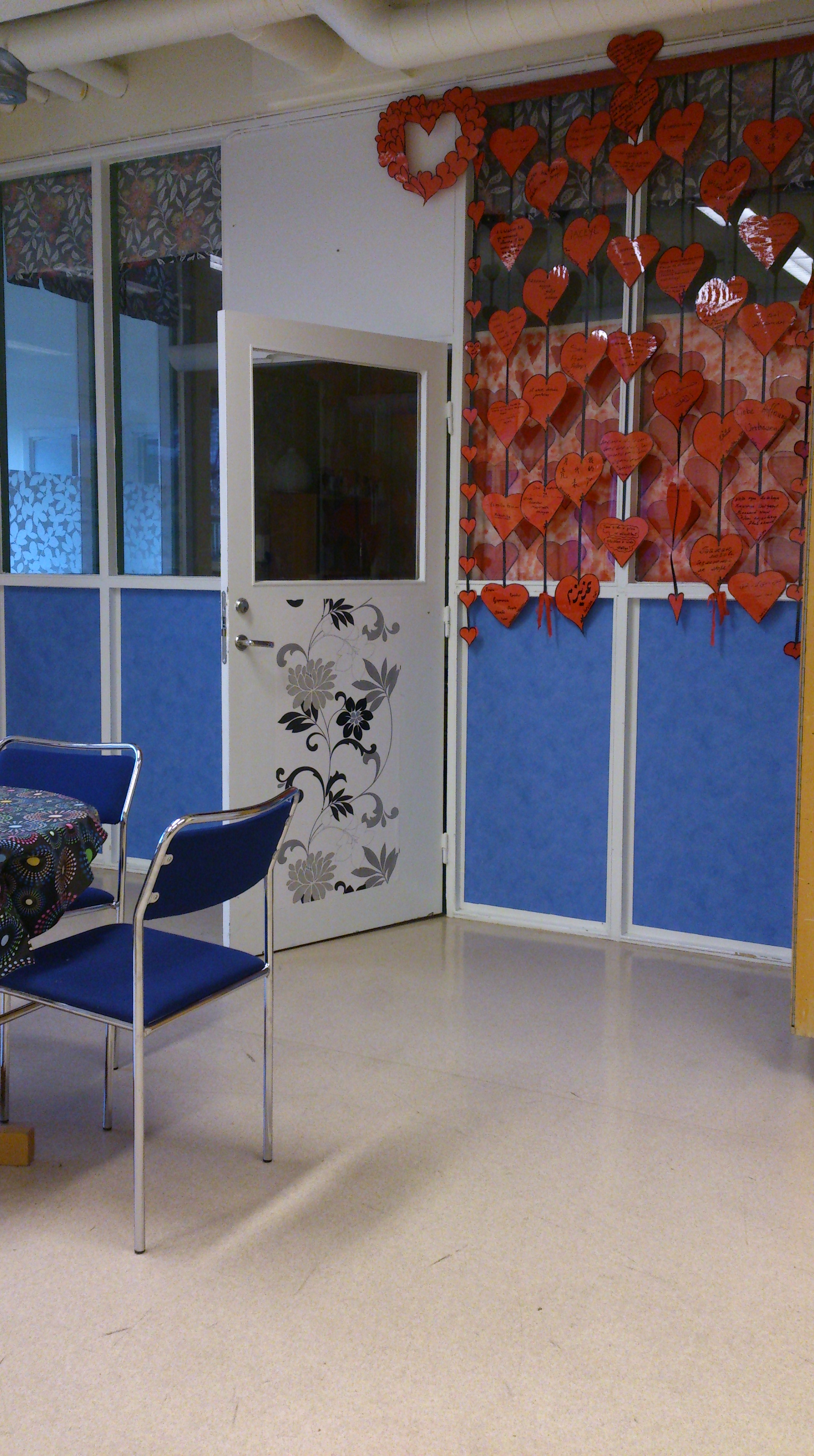
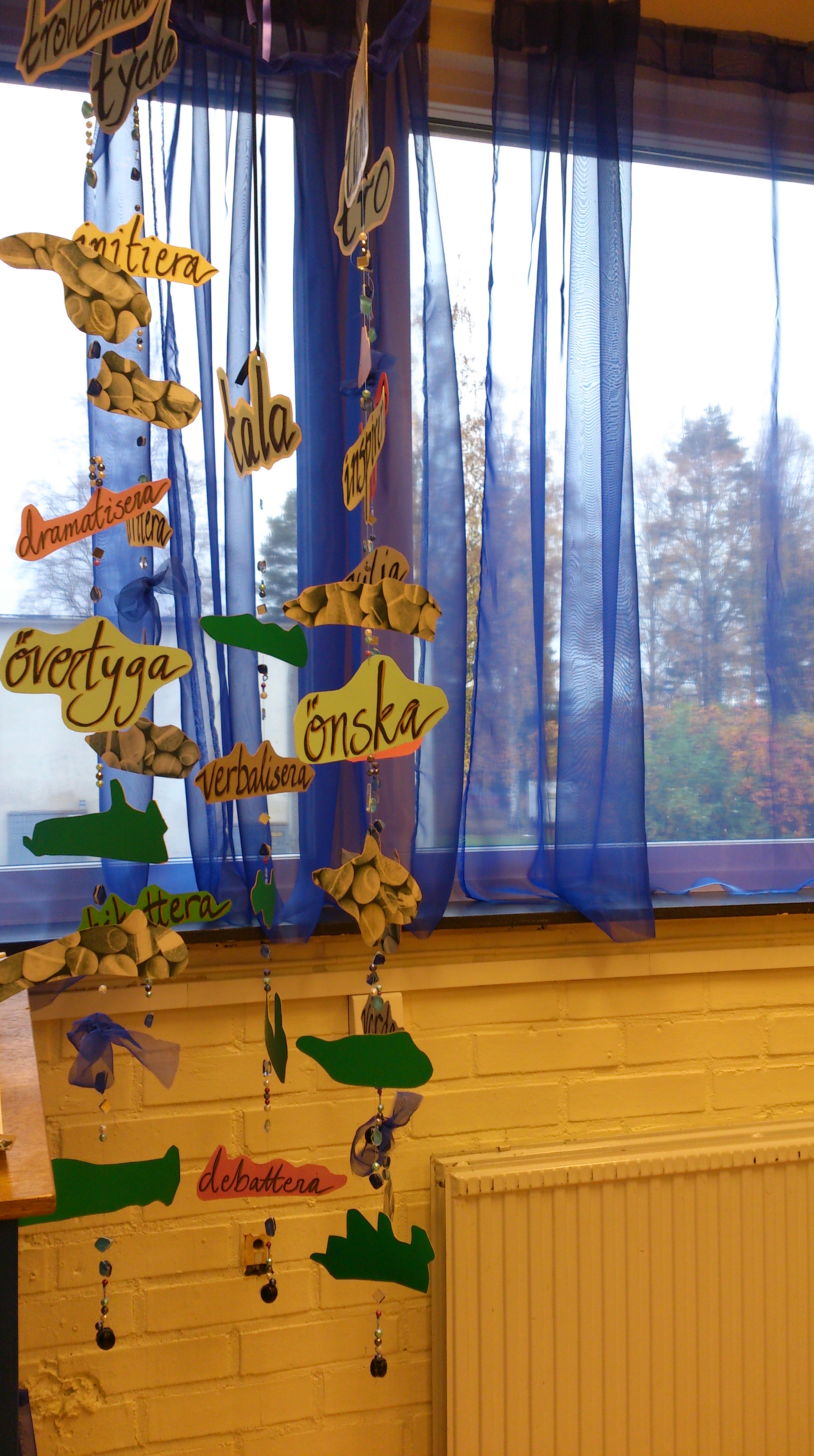
My classroom is not painted by me and it is not yellow either, but I have hanged The Blue Wallpaper myself and I have added a lot of blue accents, such as glass, fabric or decorations. Blue is my fave color and it also lead my thoughts to water or to a realxing feeling that makes me calm. In one of the corners of my room I have a waterdoor… In another corner are verbs connected to language use. The many hearts on the window to our pentry is decorated with thoughs or words on the theme LOVE. I think my students are important in many ways. I also find their background, culture and languages important. I think it is necessary for a classroom where languages are taught, that you actually can see that we speak different languages. All those languages are important. Knowing several languages is a true wisdom!

BLÅTT och GULT

 DSC_0016DSC_0017DSC_0015


The teacher I visited in NJ, USA was teaching about weather expressions in Spanish when I was there and both the students and herself were happy… and yellow is the happy color that perfectly suits a classroom for Spanish lessons. A saying by an ”unknown” author that suits the yellow classroom very well:

Keep your face to the sunshine and you cannot see the shadow

The three hundred and ninetyfirst åsic- To help students understand and find connections is what teaching’s all about!

A recycled blogpost from my visit in Pitman New Jersey 2014!

For two weeks I have had the wonderful opportunity to be among students and teachers at #Pitman Middle School in #New Jersey, #USA. I have been monitoring instruction in many different classes and seen many very good examples of teaching. My main focus has been ESL-teaching and I have seen examples of that both in primary schools and in adult classes of different kinds. Some of the adult students were part of a program for parents and were taught in classes with students from many different countries. They were preparing for a test and if they’d pass the test that would help them qualify for being American citizens. Other adults I met learned language for their own good, so to speak. They had different private reasons for taking the course and were taught in a smaller group within a local college. In every one of these differents setting and with every single teacher I have noticed high quality and a good knowledge both in what an ESL student needs and also teaching and instruction in general. When in class, I can see that many of the teachers have the same idea as I have, i.e to teach through themes or concepts rather than details. Today, since it is Halloween here, I have noticed that younger kids in primary schools here learn about the local legend #The New Jersey Devil. According to the legend he was the thirteenth child of a worn out woman who didn’t want her child. She cursed him and said ”to the devil with him!” and since then he is haunting #the Pine Barrens in New Jersey. The story is told this day since this is his birthday.

All teachers and students seem very into the idea of Halloween, even if not all schools celebrate with costumes and dresses. One of the classrooms I visited today, a classroom where Spanish is the main subject, focused on the differences between Halloween and the Mexican tradition for Dia de las Muertas  (the Day of  the Dead). The American kids get a chance to comment on what is similar or different when they compare these two holidays. The teacher help them along the way and try to get them to precise what they mean. She asks questions like ”How do you mean?”  ”What would you have thought if a loved one came back to life?” The point for the teacher is to explain that the Mexican Holiday is not at all scary or horrific, but rather a nice way of remembering your loved ones who passed away. The teacher then connects to the American people’s connections to the date 9/11 and the kids all get a chance to share the stories their parents have told them about 9/11. The idea is to show the kids that by remembering and talking about sad or scary memories, those memories get a little easier to talk about each time. Then she wraps it all up by saying THAT is what the Mexicans do when they celebrate THEIR holiday. They stick to the nice memories of a person and cherish those memories in a more happy manner, although they are dressed or disguised into skeletons etc. I was very happy to get the chance to see this lovely explanation of what the different festivities are all about. To help students understand and find connections is what teaching’s all about! I have written in Swedish about the importance of this in my tenth åsic and in my seventyeighth åsic. Thank You and Farewell #Pitman Middle School

Those of you who read Swedish are of course welcome to read other posts as well. You will find those by clicking ”På svenska” to the left on http://www.asaole.com.

For my English readers more blogposts are found by clicking ”In English” to the left on http://www.asaole.com

The three hundred and ninetieth åsic- My New Favourite Tree

A recycled blogpost from my visit in Pitman New Jersey 2014!Quercus_rubra_1.jpg (582×671)

For a couple of weeks I have had the opportunity to experience a very mild and nice autumn here in Pitman, NJ. One of the days we had +28C which is not at all like the temperature for October in Sweden. In my 71st åsic(#Sjuttioförsta åseriet), I wrote about the maples in Sweden and how I used to collect the colourful leaves in the autumn. I have always loved trees and since I live in a part of Sweden where forests are a part of the nice scenery, I always find a walk in the forest very soothing if I need to relax or find new energy. I have walked along nice streets here in Pitman, where mainly tall maples and oaks give gardens their share of fallen leaves. One kind of the tree was unfamiliar to me, but I could tell from what it looked like that it had to be a maple or an oak, so I picked up a leaf and brought it with me to #Pitman Middle School, where I asked everyone I met: ”Is this a maple or an oak?”. Most people said: ”I don’t know but I think it is…” and then two people very quickly said: ”It’s an oak, no doubt!” Now I KNOW it is an oak, since I have done what most people do nowadays… I googled it… It turned out to be a red oak.

The fallen red oak leaves has the same SOUND as the fallen Swedish maple leaves when you walk through them… The other day I took a shortcut home and ended up very far away from home in an empty yard…learning that just as ”genvägar är senvägar” , shortcuts tend to be longcuts…

One good thing by taking the ”shortcut” was that I had to walk on a narrow path in a little forest, passing a railroad to get back home. The fallen leaves in a thick layer sounded like the maple leaves from my childhood and around me both squirrels and chipmunks ran about. I knew I was very close to houses, but the trees and animals made me fly away in thoughts for a while. The beauty of coloured leaves is still the same, no matter where I am. It gives me a feeling of gratefulness to see all the colours, hear the dry sound of the leaves as I walk through them. The sunrays hardly pass through to the ground and there are merely dark soil and old leaves for the squirrels to run about in. In its lack of colours, the ground already seems ready to meet the winter. In my lack of inner compass, I also seemed ready to meet the winter… Luckily I made a correct guess and soon found my way back to Broadway again…

The three hundred and eighty-eighth åsic- Kids vs Adults, a comparison shows that FAQ are very different

A recycled blogpost from my visit in Pitman New Jersey 2014!

fragor.jpg (470×200)


Today I visited a few new classrooms where I haven’t been before. It was very interesting to again note that kids and adults do not ask the same kind of questions. Generally speaking I would say that kids like to know, for real, what it might be like to live in Sweden. They ask personal questions formed from their own point of view and seem happy to get an answer.

Some adults may have a real interest, too, BUT the interesting thing is that they tend to repeat each others questions. Check what adults have asked me the last week:

  1. Are you Irish?
  2. Is this your first time in the US?
  3. For how long will you be here?
  4. Have you visited other states in the USA?
  5. When does school start in Sweden?
  6. How many school days are there?
  7. What subjects do you teach?
  8. How many students are there in each class?
  9. What kind of grades do you use in Sweden?
  10. What American singer would be THE most famous, Elvis or Michael Jackson?

There have been a FEW more questions, but the above questions have tended to come back. Now look at the questions kids have asked:

  1. Do you celebrate Halloween?
  2. What cellphones brands do you have in Sweden?
  3. What clothes do you wear in Sweden?
  4. How far from China is Sweden?
  5. What does the Swedish national anthem sound like?
  6. What do the houses look like in Sweden?
  7. How old are your daughters?
  8. What music do you listen to in Sweden?
  9. What famous Americans are popular in Sweden?
  10. Are there IKEA:s all over Sweden?
  11. What sports do you do in Sweden?
  12. Do you eat the same food as we do?
  13. What kind of farms are there in Sweden?
  14. What do you grow in Sweden?
  15. What does the trees look like in Sweden?
  16. Does The Swedish House Mafia really come from Sweden?

Kids tend to want to know about things out of school more than the teachers do.Teachers tend to ask about school related topics. I find that most interesting. Another thing I find interesting is the way no lesson where I have been involved has been at all like the other. I have asked the kids what they wanted to know and that has lead to lessons that differed very much from each other. Being in a situation where I can choose what to share or not from what the students like to know, has thus been just like I prefer to work, i.e in a group oriented manner. I will miss this school and all the kids next week when I go home. They are all very open and welcoming and I have a great time learning more about this NJ school.

The three hundred and eighty-sixth åsic- Höstlöv, höstlov, hostlov, Fall Break!

A recycled blogpost from my visit in Pitman New Jersey 2014!

#höstlöv, #asaole

barn_host.JPG (510×315)hosta-300x252_150299504.jpg (300×252)


Four different spellings means four different things, of course they do, but let’s take a closer look at it!

  1. höstlöv= autumn leaves→ when days get colder and leaves change colours from green into more colourful yellow, orange or red
  2. höstlov=fall break→ when Swedish school kids have a week off while teachers either go to conventions or work with their local projects, or get a chance to get some busy time back.
  3. hostlov= a coughing  ”break” meaning that the planned ”höstlov” would be a week when you had to stay in bed because of coughing… 😦
  4. Fall break=höstlov
  5. Ö→In Swedish we have three different letters that you can’t find in English. They are å, ä and ö.

If I would use a computer keyboard here, in the US, I would need to find some solution to writing the Swedish letters, which would cause problems since I’m not that much of a computer person. Instead I tend to write ”Swedish” with the computers I find here, but replacing the å, ä and ö with a, a and o. There! See??? Already we have a chance to mix them up, since å and ä are not the same as a and a… So how would one tell whether the intention is to write å or ä? Knowing what reading is about, one might pretend to be Sherlock Holmes and try to find out by checking the meaning of the words around…or perhaps being Swedish might be of help…? Check these two chunks of Swedish, but spelled without the å or ä:

  1. Ett far kan braka.
  2. Titta en bat!

Let’s say you don’t know Swedish at all… Then you would think it’s something wrong with the grammar in the first sentence, I guess… or you would just assume that this person has missed out a word of maybe is dyslectic.

The first sentence may mean several things in Swedish, but knowing Swedish properly means knowing whether you would use ”en” or ”ett” (comparable to the use of ”a” or ”an” in English). A Swedish person would know that if ”far” in the first sentence actually is correct (meaning ”father”) then there has to be ”en” rather than ”ett” if written with correct use of grammar. Suppose this person assume it is a father then… On to the problem with ”braka”… That word is a verb and you would mainly use it to describe what happens if a construction of some sort break apart, such as if a tree falls over a shed in your garden, you would say that the tree fell over the shed: ”skjulet brakade sönder”. The use of ”braka” might also suggest the sound of something, not necessarily something nice… Suppose you lunch was beans… After a while you really have to fart… If that happens and you can hear a sound, you would in colloquial or dialectal Swedish say ”han brakade” meaning ”he farted”. Then, what happens with the first sentence is that you have different options now, right? Either the meaning is ”en far kan braka” meaning ”a father can fart” or we need to doublecheck the meaning of the word braka… Is there any chance for that word being spelled with either å or ä??? Oh… as a matter of fact, both would be possible to use… ”En far kan bråka” means ”a father can be messing/fighting”… ”En far kan bräka” means that the father makes the sound of a sheep. Would a father to that? Yes, maybe if he plays with his kids or something, but it is more likely that we didn’t guess right when we picked either å or ä here… So then… What next??? I suggest for us to go back to the noun… ett far… We already know that ett far is not how we would say in Swedish. We would say ”en far” if it HAD meant father…but suppose it doesn’t? ”Ett får”= a sheep, YES!!! A sheep can bleat= ”ett får kan bräka”. Guess what??? This is what you and I do in a matter of SECONDS when we read a text!!! I think that’s amazing! Don’t you?

Let’s repeat the concept…by checking the second sentence!

”Titta” means ”look”… ”en” means ”a”… bat is a word in English, but not in Swedish. A Swedish speaking person has two options here. One is to assume that the word ”bat” means the currency they use in Thailand and then also assume that the person who wrote it has missed an ”h”  in ”baht”, but more likely is for the person to read between the lines and understand that nobody would comment on Thai currency in that way and rather suggest that the ”bat” has to be spelled with either ”å” or ”ä”. When picking one of these this time it’s easy! Why is that? Well, there IS no such word as ”bät” in Swedish, so problem is solved with ”båt” meaning ”boat” and the sentence will be ”Look, a boat!”

By reading between the lines, one can get a lot of language learning, don’t you think?

The three hundred and eighty-fifth åsic- ”HALF&HALF” or Completely Wrong!

A recycled blogpost from my visit in Pitman New Jersey 2014!

I don’t drink regular milk since I have a lactose intolerance. For my visit here in the US I had to make sure there would be something to replace my usual products with and today it was time to fill the fridge again. After we got back home I wanted to comment on ”milk” in general and since ”my” family here drink something that they call ”HALF&HALF” (a mixture of milk and cream as I understand it). I wanted to know what that was. So I asked…and they both laughed. I didn’t quite get what’s wrong, but i found out soon enough. They repeated what I said and I still couldn’t get it. I said it again, ”HALF&HALF”. Then they said: ”We don’t say that!” I couldn’t understand, because on the box it clearly says ”HALF&HALF” and that was what I said, over and over again. Finally I ASKED them what THEY said then… They said, too: ”HALF&HALF”, but their sound of the ”A” was as far from mine as the distance from here to Buckingham Palace! We all laughed and made fun of the different pronunciations and what would happen if you loudly would shout out in the store HERE, but with my pronunciation: ”Dear, please go and get some ”HALF&HALF”!!

My reflection is that if my friends hadn’t pointed out that we in fact used different pronunciations for the expression, I wouldn’t have noticed. I know that may seem weird to some of you, but different accents don’t ”bother” me anymore and I know my own accent is a strange mixture of different accents. A few people in school last week suggested I’ve got an Irish accent, which I enjoyed, since I have never been there… 😀

The three hundred and eighty-fourth åsic- Fika as an ice-breaker is never wrong!

A recycled blogpost from my visit in Pitman New Jersey 2014! 

There are many times I have marvelled over the word fika and how it doesn’t seem to have any translation in many other languages. Today was another of those times! 

This morning at the ”Sweden Day” at the school I visit I shared the concept of FIKA and explained what it is to the members of the staff. I was surprised that so many seemed to like the idea of FIKA and that made me think of a completely different situation some years ago. I talked to an American woman, who was married to a Swedish man.

This woman had learned by being in Sweden what fika was, and her idea of it was pretty much like the one I wrote on the whiteboard today (which I share above). As we talked we realized that the two of us had talked to Americans about the concept of fika, but in different parts of the country. I have only met people on the East Coast and she had just talked to people in California about it. Both her friends and mine had to some extent started to USE the word fika in the American English. What I now hope for, is for both the actual WORD and also the CONCEPT to spread across the continent. That would be amazing!

One of the teachers who had fika with me this morning, came back to the classroom after a while and asked me how to use the word in a sentence if he wanted to invite someone for a fika. So now, let’s spread it! There are different ways to invite, depending of the situation, but in English you can say like this if you like:

  • Do you want some fika?
  • How about some fika?
  • Are you up to some fika?

Fika can mean just a cup of coffee or tea, or it can mean coffee+ a sandwich, or it can mean coffee+a bun, or it can mean, coffee+ bun+ cake+cookies+ tårta, which is a Swedish kind of cake with no frosting/icing, but more likely whipped cream. The funny part is that fika also can mean ALL of the mentioned categories… There are really SO many different connections to the word in Swedish that it is very difficult to explain. Instead it is necessary to see the phenomenon as something ELSE, but ”having coffee”. It is a chance to SHARE with friends. What do we share then? It is not just the COFFEE, but thoughts, ideas, gossip, memories, jokes… Having a fika with someone is paying attention to that person, having a good time together with someone for a while. That is why I want the word to spread… So please, help me ”spread the word”… 😀

TILL MINA ELEVER är här en liten ”språkruta”:

Ska vi ta en fika? Hänger du med och fikar? Kom så fikar vi! Nu skulle det sitta fint med en fika! En slät kopp (= kaffe utan något fikabröd till) fika räcker! Vi ses på fiket! Vi hinner kanske med en språngfika om vi skyndar oss? Jag har fikarast mellan nio och tio varje morgon. Men jag brukar kvällsfika vid TV:n också. Stina kör långtradare och hinner inte med så långa raster, men ibland stannar hon på ett långtradarfik.