Fyrahundraandra åseriet- Om undervisning i relation till kraven i kunskapsmålen Del 3

Vinterhimmel på Högberget, #asaole

”Eleven ska få interagera i tal och skrift samt producera talat språk och olika texter, på egen hand och tillsammans med andra, och med stöd av olika hjälpmedel och medier. Undervisningen ska ge eleven möjlighet att använda omvärlden som en resurs för kontakter, information och lärande samt bidra till att eleven utvecklar förståelse för hur man söker, värderar, väljer och tillägnar sig innehåll från olika källor för information, kunskaper och upplevelser.” (Skolverket, 2016).

Ovanstående citat är hämtat ur syftet för ämnet svenska som andraspråk för årskurs nio och jag undervisar vuxna i en kurs som ska hantera detta kunskapsinnehåll. Som jag nämnde i mitt förra åseri, har vi utgått ifrån tidningsartiklar om snökaoset i Stockholm för att visa hur en typisk tidningsartikel ser ut. Men därifrån kan man jobba med hur man skriver insändare och debattinlägg och liknande. Men hur får man till en slagkraftig argumenterande text? Här nedan är ett tänkbart ”recept”…

Nu när vi jobbar med att förstå vad man gör när man argumenterar och samtidigt också övar oss på att skriva argumenterande texter, blir det viktigt för mig att sätta ord på hur man kan planera för sitt skrivande, till exempel genom att dela med mig av enkla upplägg, som går att applicera om och om igen på olika ämnen. OM man lär sig en ”teknik” så kan man förfina den genom att träna upprepade gånger både enskilt och tillsammans med kamrater eller läraren.

Det finns många tänkbara upplägg för att skriva en argumenterande text, men ganska vanligt är att börja med en tes, alltså en bärande tanke som egentligen är din huvudidé med hela texten. För att komma igång alls med ämnet, så behöver man utgå ifrån tesen och söka argument som både stöder och kritiserar den. Man kan jobba med ett antal argument på detta sätt, men ibland vinner man på att vara disciplinerad och inte ta upp fler än kanske tre argument. Till dessa tre argument, lägger man en avslutande del där man aknyter till inledningen genom att tesen upprepas tillsammans med det starkaste argumentet.

Men om man nu endast ska ta upp tre ynka argument, så är det förstås viktigt att tänka på hur man ordnar dem… Det är bra att spara det bästa till sist. Om du bedömer att du har tre argument, där ett är extra bra, så ska du avsluta med det. Det argument du anser är näst bäst är det du ska börja med. Det svagaste argumentet, ska du placera som nummer två, så att det kommer att hamna i skuggan av det starkaste, som du placerar sist innan avslutningen. Läsaren får på det sättet förhoppningsvis intrycket av att du har tre lika starka argument i din text. För vart och ett av argumenten, ska du tänka ut ett motargument, som du i bästa fall också bemöter direkt, så att du tydligt visar läsaren att ditt eget argument klarar sig i konkurrensen. Du har ju en bärande tanke, som du driver framåt i texten.

Trots att det finns ett recept som det jag nyss presenterat, så kan utmaningen för en elev som studerar svenska som andraspråk vara de ord och uttryck man behöver använda i en argumenterande text. Vilka ord och uttryck passar bäst för att prata om fördelar och förtjänster? Vilka ord och begrepp har redan en negativ klang? Det är min erfarenhet att man kan träna även på det… Alltså vilka ord som är ”positiva” eller ”negativa” och vilka vi kan använda på ett neutralt sätt.  Jag brukar jobba muntligt med det i en samarbetsövning, som jag berättar mer om i ett kommande åseri.

I min undervisning jobbar jag mycket med att förankra texttyperna, så att eleverna känner att de lär sig saker som kan vara bra att kunna. Till exempel om man läst en ledare eller en debattartikel i tidningen och inte alls delar skribentens uppfattning, så kan det vara bra att åtminstone känna till hur man kan skriva, om man skulle få för sig att författa ett debattinlägg… I nästa åseri, det #fyrahundratredje åseriet, kommer tips om hur man på ett enkelt sätt kan göra en åskådlig genomgång om olika texttyper.

Fyrahundraförsta åseriet- Om undervisning i relation till kraven i kunskapsmålen Del 2

#iskristaller på fönster, #asaole

”Eleven ska ges möjlighet att utveckla kunskaper om livsvillkor, samhällsfrågor och kulturella företeelser i olika sammanhang och områden där svenska används. Undervisningen ska stimulera elevens nyfikenhet på språk och kultur… ” (Skolverket, 2016).


Ovanstående citat är hämtat ur syftet för ämnet svenska som andraspråk för årskurs nio och jag undervisar vuxna i en kurs som ska hantera detta kunskapsinnehåll. När jag väljer texter eller teman till min undervisning, försöker jag knyta an till så många kursplanemål som möjligt vid varje tillfälle, eftersom det dels är tidsbesparande, dels skapar möjlighet till många olika utgångar. Samtidigt lägger jag stor vikt vid att det vi ska läsa engagerar eleverna innehållsmässigt och har en tydlig koppling till alldeles vanliga företeelser i vårt samhälle. Det kan handla om en så enkel sak som ett väderomslag… Det så kallade snökaoset i Stockholm fick rubriker och för mig fanns det en uppsjö av artiklar att välja bland för att prata om texttypen artikel. Vi går igenom artikelns delar, eftersom eleverna behöver lära sig de ord och begrepp vi använder för att benämna artikelns kännetecken. Det handlar alltså om ord som rubrik, underrubrik, bild, bildtext, spalt, byline och brödtext. 

Nu när vi jobbar med att förstå vad man gör när man argumenterar och samtidigt också övar oss på att skriva argumenterande texter, blir det viktigt för mig att hitta teman som man kanske har en åsikt om, men som inte innebär att hela klassen går hem från lektionen i djupaste osämja. Det har nyss snöat alldeles otroligt mycket, men inte där vi bor, utan i landets huvudstad Stockholm, vilket har gett olika avtryck i medierna. Därför tog jag med mig en artikel om detta till skolan. ”Skolor i Stockholm stänger på grund av snön” ( Aftonbladet 161110). Artikeln handlar om att man under gårdagen hade stängt flera skolor i stockholmsområdet på grund av det intensiva snöfallet. Vi pratade i klassen om artikelns innehåll och i slutet av lektionen nämnde jag i förbigående att varje gång det snöar på detta sätt, så brukar det komma nya artiklar, skrivna av personer i norra Sverige, som vill upplysa stockholmarna om hur en slipsten ska dras… Jag uppmanade dem att följa nyhetsflödet i just Aftonbladet, för att det ju var där som min exempelartikel funnits.

När jag kom åter till mitt arbetsrum och kastade en blick på Aftonbladets löpsedel hade man redan publicerat den typ av artikel som jag hade syftat på… Den passande titeln ”Skärp er Stockholm, det är ju bara snö” säger ju allt och för mina utlandsfödda elever är den säkert ett ganska bra exempel på den bild jag målade upp med diskussioner i media om vardagsföreteelser som ibland kan leda till en lång rad insändare eller debattartiklar innan ämnet anses uttömt. Läs gärna artikeln:

http://www.aftonbladet.se/nyheter/article23887824.ab

Det är också viktigt att som lärare hjälpa eleverna att dra språkliga slutsatser i texterna, se på hantverket bakom en text, hur den är uppbyggd och vilka kännetecken den har och vilka källor artikelförfattaren har valt för sin text. I ett vidare perspektiv kan man självfallet också diskutera källkritik.

Det händer ibland att elever tycker att, visst, de kan skriva, men jag då?? Borde inte läraren själv skriva i så fall? Idag blev jag på detta sätt utmanad av en elev som ville att jag skulle svara på lärobokens insändare och visa hur jag skulle skriva. Det var bra med den där utmaningen, tror jag, för på min rast snodde jag ihop ett tänkbart svar på den aktuella insändaren och sedan kunde vi på ett enklare sätt prata om vad i insändaren som jag hade valt att bemöta, hur man kan visa att man tydligt är emot eller tydligt håller med insändarskribenten etc. Det blev också enklare för mig att förklara spelet med ord som har ett visst inbyggt värde. Att som ny i språket förstå nivåer och stilistiska skillnader är svårt, men genom exempel som man samtalar om, blir det möjligt. I det #fyrahundraandra åseriet kommer mer om att skriva argumenterande.

The three hundred and ninetyfifth åsic- The Yellow Wall and The Blue Wallpaper

I used to teach in another classroom a couple of years ago. When I started off teaching there, I had an opportunity to decide for myself what the classroom would look like. I think that is one of the reasons that I liked it there. When moving out a few months ago, I removed all the details because I wanted to give the new teachers the same opportunity to do whatever they wanted to make the classroom feel like ”theirs”.

This is what I wrote when I was still teaching in my old room: 

Charlotte Perkins Gilman’s The Yellow Wallpaper is an American short story read  by many, but how many of the readers have spent a fortnight of pure creative language learning in a yellow classroom ? The teacher had painted her classroom herself and turned the dark dull room in the basement into a positive oasis for learning. All walls were painted in a bright yellow colour. Her combination of gifts from previous students, her own creations or things she had got here and there, together with wisdom on little plaques or instruction posters with different themes like weekdays, phrases or words for certain occasions, gave the impression of a nice and welcoming place where the soul of learning was more important than anything else. Soul in English almost sounds like sun in Swedish, sol.

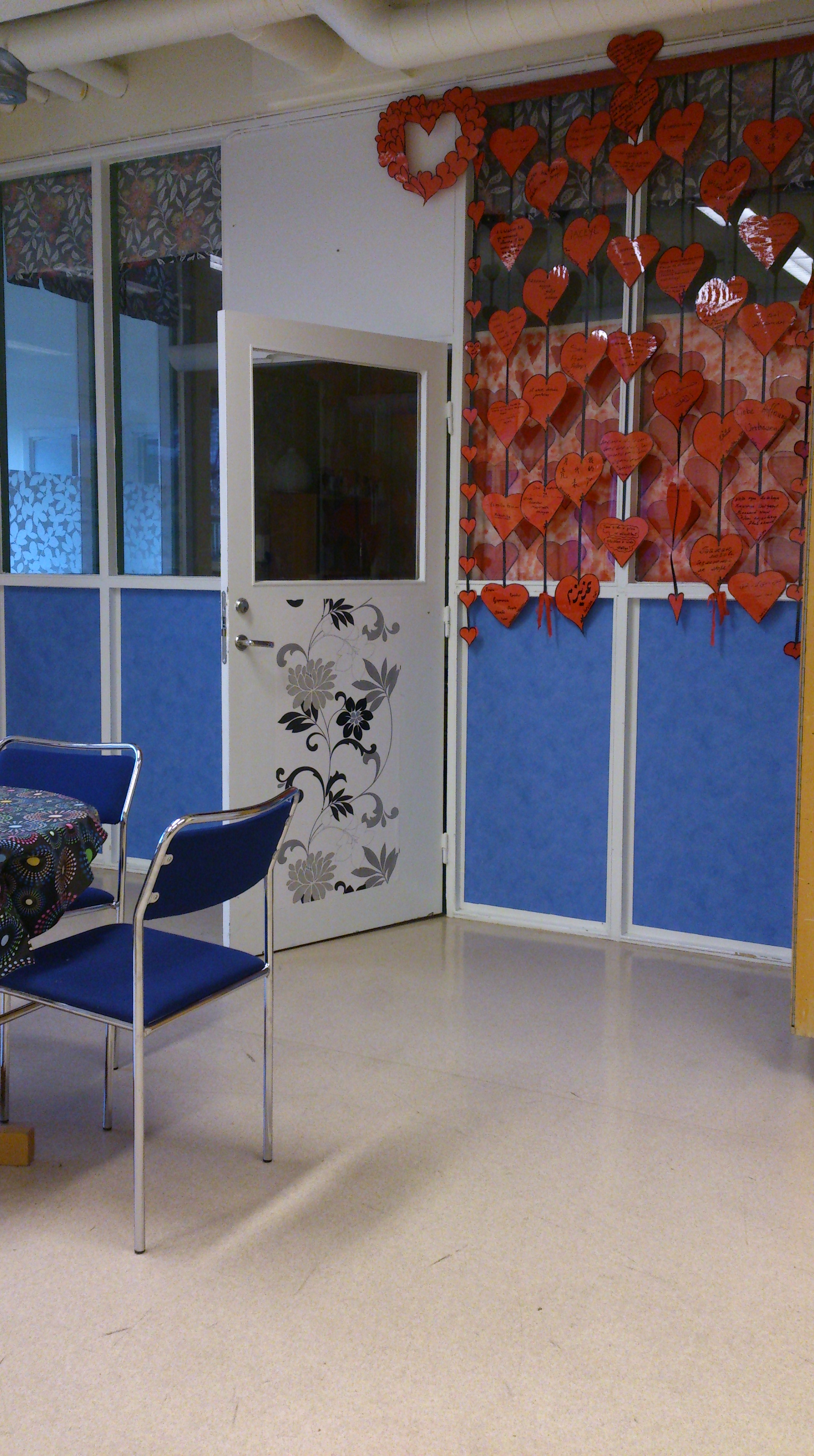
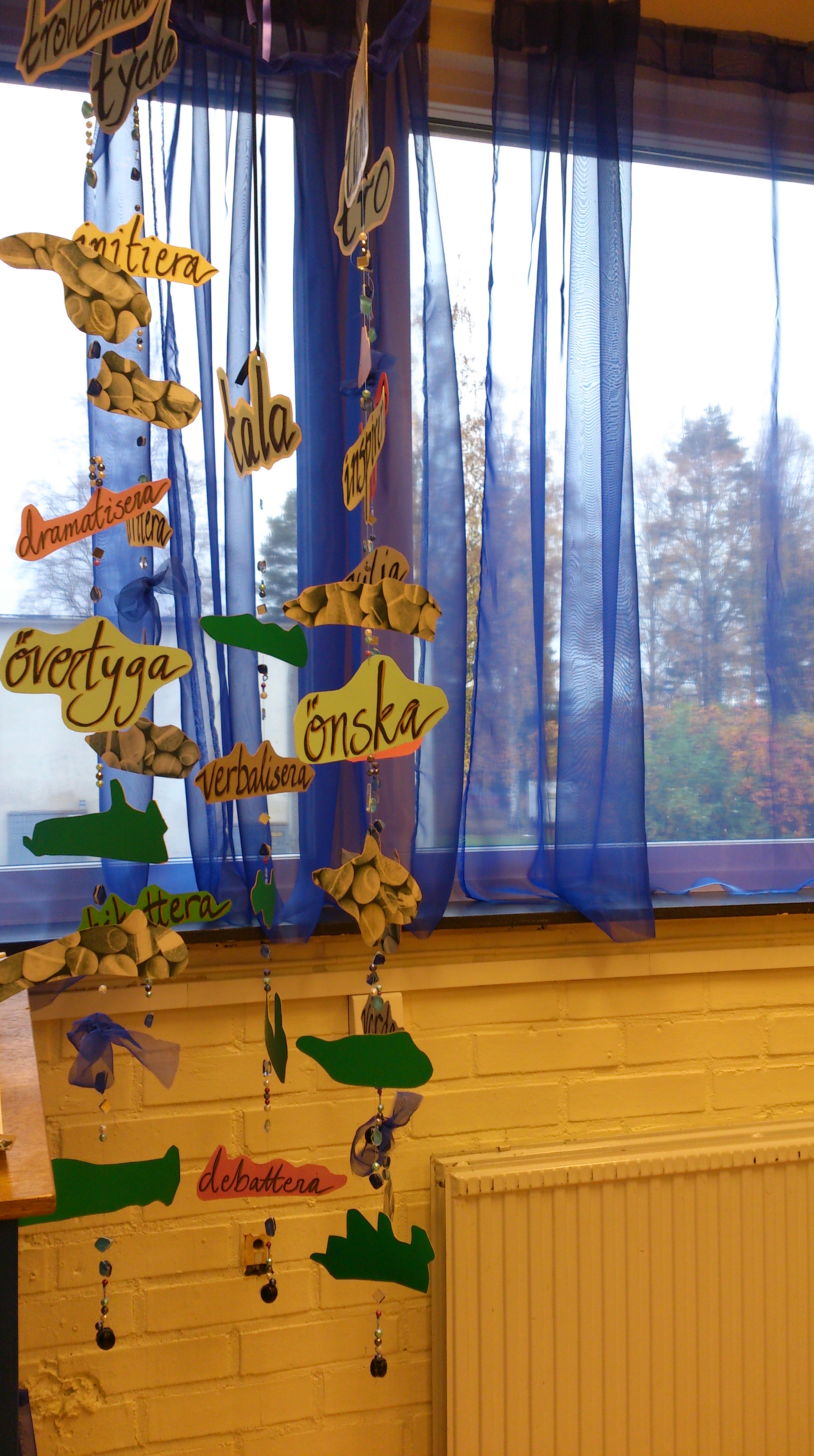
My classroom is not painted by me and it is not yellow either, but I have hanged The Blue Wallpaper myself and I have added a lot of blue accents, such as glass, fabric or decorations. Blue is my fave color and it also lead my thoughts to water or to a realxing feeling that makes me calm. In one of the corners of my room I have a waterdoor… In another corner are verbs connected to language use. The many hearts on the window to our pentry is decorated with thoughs or words on the theme LOVE. I think my students are important in many ways. I also find their background, culture and languages important. I think it is necessary for a classroom where languages are taught, that you actually can see that we speak different languages. All those languages are important. Knowing several languages is a true wisdom!

BLÅTT och GULT

 DSC_0016DSC_0017DSC_0015


The teacher I visited in NJ, USA was teaching about weather expressions in Spanish when I was there and both the students and herself were happy… and yellow is the happy color that perfectly suits a classroom for Spanish lessons. A saying by an ”unknown” author that suits the yellow classroom very well:

Keep your face to the sunshine and you cannot see the shadow

The three hundred and ninetieth åsic- My New Favourite Tree

A recycled blogpost from my visit in Pitman New Jersey 2014!Quercus_rubra_1.jpg (582×671)

For a couple of weeks I have had the opportunity to experience a very mild and nice autumn here in Pitman, NJ. One of the days we had +28C which is not at all like the temperature for October in Sweden. In my 71st åsic(#Sjuttioförsta åseriet), I wrote about the maples in Sweden and how I used to collect the colourful leaves in the autumn. I have always loved trees and since I live in a part of Sweden where forests are a part of the nice scenery, I always find a walk in the forest very soothing if I need to relax or find new energy. I have walked along nice streets here in Pitman, where mainly tall maples and oaks give gardens their share of fallen leaves. One kind of the tree was unfamiliar to me, but I could tell from what it looked like that it had to be a maple or an oak, so I picked up a leaf and brought it with me to #Pitman Middle School, where I asked everyone I met: ”Is this a maple or an oak?”. Most people said: ”I don’t know but I think it is…” and then two people very quickly said: ”It’s an oak, no doubt!” Now I KNOW it is an oak, since I have done what most people do nowadays… I googled it… It turned out to be a red oak.

The fallen red oak leaves has the same SOUND as the fallen Swedish maple leaves when you walk through them… The other day I took a shortcut home and ended up very far away from home in an empty yard…learning that just as ”genvägar är senvägar” , shortcuts tend to be longcuts…

One good thing by taking the ”shortcut” was that I had to walk on a narrow path in a little forest, passing a railroad to get back home. The fallen leaves in a thick layer sounded like the maple leaves from my childhood and around me both squirrels and chipmunks ran about. I knew I was very close to houses, but the trees and animals made me fly away in thoughts for a while. The beauty of coloured leaves is still the same, no matter where I am. It gives me a feeling of gratefulness to see all the colours, hear the dry sound of the leaves as I walk through them. The sunrays hardly pass through to the ground and there are merely dark soil and old leaves for the squirrels to run about in. In its lack of colours, the ground already seems ready to meet the winter. In my lack of inner compass, I also seemed ready to meet the winter… Luckily I made a correct guess and soon found my way back to Broadway again…

The three hundred and eighty-eighth åsic- Kids vs Adults, a comparison shows that FAQ are very different

A recycled blogpost from my visit in Pitman New Jersey 2014!

fragor.jpg (470×200)


Today I visited a few new classrooms where I haven’t been before. It was very interesting to again note that kids and adults do not ask the same kind of questions. Generally speaking I would say that kids like to know, for real, what it might be like to live in Sweden. They ask personal questions formed from their own point of view and seem happy to get an answer.

Some adults may have a real interest, too, BUT the interesting thing is that they tend to repeat each others questions. Check what adults have asked me the last week:

  1. Are you Irish?
  2. Is this your first time in the US?
  3. For how long will you be here?
  4. Have you visited other states in the USA?
  5. When does school start in Sweden?
  6. How many school days are there?
  7. What subjects do you teach?
  8. How many students are there in each class?
  9. What kind of grades do you use in Sweden?
  10. What American singer would be THE most famous, Elvis or Michael Jackson?

There have been a FEW more questions, but the above questions have tended to come back. Now look at the questions kids have asked:

  1. Do you celebrate Halloween?
  2. What cellphones brands do you have in Sweden?
  3. What clothes do you wear in Sweden?
  4. How far from China is Sweden?
  5. What does the Swedish national anthem sound like?
  6. What do the houses look like in Sweden?
  7. How old are your daughters?
  8. What music do you listen to in Sweden?
  9. What famous Americans are popular in Sweden?
  10. Are there IKEA:s all over Sweden?
  11. What sports do you do in Sweden?
  12. Do you eat the same food as we do?
  13. What kind of farms are there in Sweden?
  14. What do you grow in Sweden?
  15. What does the trees look like in Sweden?
  16. Does The Swedish House Mafia really come from Sweden?

Kids tend to want to know about things out of school more than the teachers do.Teachers tend to ask about school related topics. I find that most interesting. Another thing I find interesting is the way no lesson where I have been involved has been at all like the other. I have asked the kids what they wanted to know and that has lead to lessons that differed very much from each other. Being in a situation where I can choose what to share or not from what the students like to know, has thus been just like I prefer to work, i.e in a group oriented manner. I will miss this school and all the kids next week when I go home. They are all very open and welcoming and I have a great time learning more about this NJ school.

The three hundred and eightyseventh åsic- A light in the dark

#asaole, asa-och-zombie-i-smithsville

A recycled blogpost from my visit in Pitman New Jersey 2014!

Today I have had a wonderful day with my friends in Smithville. I had lots of time to marvel over the celebration of Halloween, that in a way already started with a planned ”Zombie Parade” that would take place this evening. People were dressed out as zombies and it was very interesting to note that there was no difference in age. Old or young didn’t seem to matter…

I am brought up with the thought of All Saints Day as a serious day when one go to the graveyard and put candles there to show respect for the dead. I have also many years sang in church in different choirs. The music was always very religious and filled with sorrow. Last year my daughters and I took a late walk to the graveyard when it was pitch dark outside. The darkness and the many nice lanterns made our walk exciting and solemn at the same time as it was creating a bonding that served as a platform for deep thoughts about life. We shared our viewpoints of what will happen after death and also what people we missed most of all when they had passed away. The moment in the graveyard was very far from my experience today.

I can’t wait to see what Friday will bring. Then I’m told that many kids in the neighbourhood will come to ask ”Trick or Treat”. I’m excited about it, but at the same time surprised at the fact that the Americans seem to go ”all in” for their celebration of Halloween. I met some of the ”walking dead” today and this couple made an impact on me, since they were no ten-year-olds. Scary!

DSC_0080


The three hundred and eighty-sixth åsic- Höstlöv, höstlov, hostlov, Fall Break!

A recycled blogpost from my visit in Pitman New Jersey 2014!

#höstlöv, #asaole

barn_host.JPG (510×315)hosta-300x252_150299504.jpg (300×252)


Four different spellings means four different things, of course they do, but let’s take a closer look at it!

  1. höstlöv= autumn leaves→ when days get colder and leaves change colours from green into more colourful yellow, orange or red
  2. höstlov=fall break→ when Swedish school kids have a week off while teachers either go to conventions or work with their local projects, or get a chance to get some busy time back.
  3. hostlov= a coughing  ”break” meaning that the planned ”höstlov” would be a week when you had to stay in bed because of coughing… 😦
  4. Fall break=höstlov
  5. Ö→In Swedish we have three different letters that you can’t find in English. They are å, ä and ö.

If I would use a computer keyboard here, in the US, I would need to find some solution to writing the Swedish letters, which would cause problems since I’m not that much of a computer person. Instead I tend to write ”Swedish” with the computers I find here, but replacing the å, ä and ö with a, a and o. There! See??? Already we have a chance to mix them up, since å and ä are not the same as a and a… So how would one tell whether the intention is to write å or ä? Knowing what reading is about, one might pretend to be Sherlock Holmes and try to find out by checking the meaning of the words around…or perhaps being Swedish might be of help…? Check these two chunks of Swedish, but spelled without the å or ä:

  1. Ett far kan braka.
  2. Titta en bat!

Let’s say you don’t know Swedish at all… Then you would think it’s something wrong with the grammar in the first sentence, I guess… or you would just assume that this person has missed out a word of maybe is dyslectic.

The first sentence may mean several things in Swedish, but knowing Swedish properly means knowing whether you would use ”en” or ”ett” (comparable to the use of ”a” or ”an” in English). A Swedish person would know that if ”far” in the first sentence actually is correct (meaning ”father”) then there has to be ”en” rather than ”ett” if written with correct use of grammar. Suppose this person assume it is a father then… On to the problem with ”braka”… That word is a verb and you would mainly use it to describe what happens if a construction of some sort break apart, such as if a tree falls over a shed in your garden, you would say that the tree fell over the shed: ”skjulet brakade sönder”. The use of ”braka” might also suggest the sound of something, not necessarily something nice… Suppose you lunch was beans… After a while you really have to fart… If that happens and you can hear a sound, you would in colloquial or dialectal Swedish say ”han brakade” meaning ”he farted”. Then, what happens with the first sentence is that you have different options now, right? Either the meaning is ”en far kan braka” meaning ”a father can fart” or we need to doublecheck the meaning of the word braka… Is there any chance for that word being spelled with either å or ä??? Oh… as a matter of fact, both would be possible to use… ”En far kan bråka” means ”a father can be messing/fighting”… ”En far kan bräka” means that the father makes the sound of a sheep. Would a father to that? Yes, maybe if he plays with his kids or something, but it is more likely that we didn’t guess right when we picked either å or ä here… So then… What next??? I suggest for us to go back to the noun… ett far… We already know that ett far is not how we would say in Swedish. We would say ”en far” if it HAD meant father…but suppose it doesn’t? ”Ett får”= a sheep, YES!!! A sheep can bleat= ”ett får kan bräka”. Guess what??? This is what you and I do in a matter of SECONDS when we read a text!!! I think that’s amazing! Don’t you?

Let’s repeat the concept…by checking the second sentence!

”Titta” means ”look”… ”en” means ”a”… bat is a word in English, but not in Swedish. A Swedish speaking person has two options here. One is to assume that the word ”bat” means the currency they use in Thailand and then also assume that the person who wrote it has missed an ”h”  in ”baht”, but more likely is for the person to read between the lines and understand that nobody would comment on Thai currency in that way and rather suggest that the ”bat” has to be spelled with either ”å” or ”ä”. When picking one of these this time it’s easy! Why is that? Well, there IS no such word as ”bät” in Swedish, so problem is solved with ”båt” meaning ”boat” and the sentence will be ”Look, a boat!”

By reading between the lines, one can get a lot of language learning, don’t you think?

The three hundred and eighty-fifth åsic- ”HALF&HALF” or Completely Wrong!

A recycled blogpost from my visit in Pitman New Jersey 2014!

I don’t drink regular milk since I have a lactose intolerance. For my visit here in the US I had to make sure there would be something to replace my usual products with and today it was time to fill the fridge again. After we got back home I wanted to comment on ”milk” in general and since ”my” family here drink something that they call ”HALF&HALF” (a mixture of milk and cream as I understand it). I wanted to know what that was. So I asked…and they both laughed. I didn’t quite get what’s wrong, but i found out soon enough. They repeated what I said and I still couldn’t get it. I said it again, ”HALF&HALF”. Then they said: ”We don’t say that!” I couldn’t understand, because on the box it clearly says ”HALF&HALF” and that was what I said, over and over again. Finally I ASKED them what THEY said then… They said, too: ”HALF&HALF”, but their sound of the ”A” was as far from mine as the distance from here to Buckingham Palace! We all laughed and made fun of the different pronunciations and what would happen if you loudly would shout out in the store HERE, but with my pronunciation: ”Dear, please go and get some ”HALF&HALF”!!

My reflection is that if my friends hadn’t pointed out that we in fact used different pronunciations for the expression, I wouldn’t have noticed. I know that may seem weird to some of you, but different accents don’t ”bother” me anymore and I know my own accent is a strange mixture of different accents. A few people in school last week suggested I’ve got an Irish accent, which I enjoyed, since I have never been there… 😀

The three hundred and eighty-fourth åsic- Fika as an ice-breaker is never wrong!

A recycled blogpost from my visit in Pitman New Jersey 2014! 

There are many times I have marvelled over the word fika and how it doesn’t seem to have any translation in many other languages. Today was another of those times! 

This morning at the ”Sweden Day” at the school I visit I shared the concept of FIKA and explained what it is to the members of the staff. I was surprised that so many seemed to like the idea of FIKA and that made me think of a completely different situation some years ago. I talked to an American woman, who was married to a Swedish man.

This woman had learned by being in Sweden what fika was, and her idea of it was pretty much like the one I wrote on the whiteboard today (which I share above). As we talked we realized that the two of us had talked to Americans about the concept of fika, but in different parts of the country. I have only met people on the East Coast and she had just talked to people in California about it. Both her friends and mine had to some extent started to USE the word fika in the American English. What I now hope for, is for both the actual WORD and also the CONCEPT to spread across the continent. That would be amazing!

One of the teachers who had fika with me this morning, came back to the classroom after a while and asked me how to use the word in a sentence if he wanted to invite someone for a fika. So now, let’s spread it! There are different ways to invite, depending of the situation, but in English you can say like this if you like:

  • Do you want some fika?
  • How about some fika?
  • Are you up to some fika?

Fika can mean just a cup of coffee or tea, or it can mean coffee+ a sandwich, or it can mean coffee+a bun, or it can mean, coffee+ bun+ cake+cookies+ tårta, which is a Swedish kind of cake with no frosting/icing, but more likely whipped cream. The funny part is that fika also can mean ALL of the mentioned categories… There are really SO many different connections to the word in Swedish that it is very difficult to explain. Instead it is necessary to see the phenomenon as something ELSE, but ”having coffee”. It is a chance to SHARE with friends. What do we share then? It is not just the COFFEE, but thoughts, ideas, gossip, memories, jokes… Having a fika with someone is paying attention to that person, having a good time together with someone for a while. That is why I want the word to spread… So please, help me ”spread the word”… 😀

TILL MINA ELEVER är här en liten ”språkruta”:

Ska vi ta en fika? Hänger du med och fikar? Kom så fikar vi! Nu skulle det sitta fint med en fika! En slät kopp (= kaffe utan något fikabröd till) fika räcker! Vi ses på fiket! Vi hinner kanske med en språngfika om vi skyndar oss? Jag har fikarast mellan nio och tio varje morgon. Men jag brukar kvällsfika vid TV:n också. Stina kör långtradare och hinner inte med så långa raster, men ibland stannar hon på ett långtradarfik. 


The three hundred and eighty-second åsic- Second Day in an American Teacher’s Hectic World

Everybody likes Pitman, #asaole

A recycled blogpost from my visit in Pitman New Jersey 2014!

At home I don’t teach English, but Swedish as a Second Language. This evening I had the great opportunity to visit an adult learner’s group in Spanish at a College not far from where I am. The students were all taking lessons in Spanish, but volunteered to talk to me about what the conditions are for adult learners at this level in the school system. I found our conversation most interesting and will share their viewpoint with both my students and my teaching friend at basic level of English.

Earlier today I first met with a few children with special needs. I shared with them a few thoughts on what it is like to live in a country where we have monopoly money and a” fairy-tale-like” reality with a king…

I also had a chance to contribute with Swedish words in grade six while they were taking a Spanish lesson about furniture in different rooms of a house. Then I discussed with a group of eightgraders why so many Swedes left Sweden a hundred years ago.

I then had a nice and long chat with one of the teachers who has been a resident of Pitman almost all her life, apart from a short period down south. She told me all there is to know about the little town and I was happy to learn all that first hand, rather than read about it.

On Friday a few of the teachers have planned for a Sweden day, where the students will be getting a whole lot of information about Sweden, but also try some typical Swedish activities. I will contribute with a slideshow about Sweden and explain why the Dala horse is a symbol for  Sweden. The collaboration with an art teacher at this school also led to an idea where we let the kids know a little about how one can paint a typical ”kurbits”.

Tomorrow we’re off to Atlantic City, my teaching friend and I. We will study ESL as the NJ authorities wants it to be. I look forward to that very much. I don’t need anyone to rock my cradle! I am exhausted, but I’m having so much fun! Teaching is my life! ❤