Twohundred and fifty-seventh asic- A Swedish ”hen” is born!

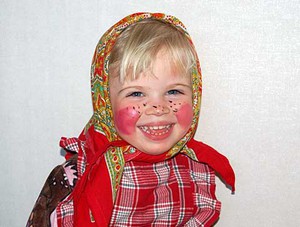
The Swedish Royal Family is always in focus in one way or the other. This time for the reason of a little newborn, that we so far do not know much about. According to the press release a child is born… Not a girl or boy, but a child.

Swedish is a german language and generally we would use the pronouns he, she or it, to refer to anyone or anything, but a few years ago, a new pronoun was introduced, HEN, pronounced exactly as one would pronounce the feathered mother of a chicken…

HEN

For a few more minutes now, we still don’t know whether the new little ”hen” is a he or a she. What we DO know is how much attention Princess Sofia and Prince Carl Philip received by keeping the sex of the child a secret like this.

One Hundred and Ninetyeighth Asic- Same Procedure as Last Year, James?

Many of the traditions we follow have an origin in religion or culture and may be deeply rooted for several other reasons. I remember first time I heard a reference to ”the ball drop”.  Of course I did not understand what it was all about, simply because I didn’t follow American traditions for New Year’s Eve. When I watched ”When Harry Met Sally” for the first time and when I followed the Broadcast from Times Square, NYC and under Billy Joel’s guidance could meet a new millennium, I understood the connection…

Interestingly enough, from the 1950s and on, many of the Swedish traditions are closely connected to TV, but none of us watch a ball drop… As I have written before, we watch Donald Duck at three o’clock on Christmas Eve and on New Year’s Eve we also gather in front of the TV set to watch a certain TV-show, or rather gatered, since many people have changed their habits for New Years Eve. For many years we had just one single TV-channel, but when I was a child we at least had two channels… 😉

I remember watching two particular TV-shows on New Year’s Eve. The first show was a British production called ”Dinner for One” in English(”Grevinnan och betjänten” in Swedish). It was filmatised in 1948, so of course it’s black and white back then. Please follow the link below! The manuscript is written by Lauri Wylie and the two participating actors, May Warden as the Duchess ”Miss Sophie” and Freddie Frinton as her waitor ”James” have entertained Swedish viewers for decades. The repeated dialogue makes it hilarious along with excellent performance from both actors.

James: Same procedure as last year, Miss Sophie?

Miss Sophie: Same procedure as every year, James!

Dinner for One

The next traditional TV-show is connected to the turning of the year, at midnight on New Year’s Eve. Many Swedish traditions are broadcasted at a famous open air museum in Stockholm, called Skansen. In the summer they have a weekly sing-along-concert with famous artists and during the winter you can for instance visit Skansen for traditional open air fairs. On New Year’s Eve a concert is held on Skansen. The performance consists of traditional choir music, such as ”Sverige” (= Sweden) by Verner von Heidenstam with music by Vilhelm Stenhammar.

At the very end of the concert, a famous actor/actress reads a poem by Lord Albert Tennyson, called ”Ring Out, Wild Bells”. See quote below! (source; wikipedia.org) This year the poem will be performed by the Swedish opera singer Malena Ernman. Since this time of the year is generally very cold in Sweden, I remember from my childhood how the actor/actress reading the poem would generally be dressed in a thick fur and the following applause from the audience was softened by gloves and mittens… This year, however, the weather is not quite as cold. Who knows? We may hear a loudlier applause by midnight!

”Ring Out, Wild Bells”(1850) by Lord Albert Tennyson

Ring out, wild bells, to the wild sky,

The flying cloud, the frosty light

The year is dying in the night;

Ring out, wild bells, and let him die.

Ring out the old, ring in the new,
Ring, happy bells, across the snow:
The year is going, let him go;
Ring out the false, ring in the true.
Ring out the grief that saps the mind,
For those that here we see no more,
Ring out the feud of rich and poor,
Ring in redress to all mankind.
Ring out a slowly dying cause,
And ancient forms of party strife;
Ring in the nobler modes of life,
With sweeter manners, purer laws.
Ring out the want, the care, the sin,
The faithless coldness of the times;
Ring out, ring out thy mournful rhymes,
But ring the fuller minstrel in.
Ring out false pride in place and blood,
The civic slander and the spite;
Ring in the love of truth and right,
Ring in the common love of good.
Ring out old shapes of foul disease,
Ring out the narrowing lust of gold;
Ring out the thousand wars of old,
Ring in the thousand years of peace.

Ring in the valiant man and free,

The larger heart the kindlier hand;

Ring out the darkness of the land,

Ring in the Christ that is to be.

The ninetyfirst åsic- To help students understand and find connections is what teaching’s all about!

For two weeks I have had the wonderful opportunity to be among students and teachers at #Pitman Middle School in #New Jersey, #USA. I have been monitoring instruction in many different classes and seen many very good examples of teaching. My main focus has been ESL-teaching and I have seen examples of that both in primary schools and in adult classes of different kinds. Some of the adult students were part of a program for parents and were taught in classes with students from many different countries. They were preparing for a test and if they’d pass the test that would help them qualify for being American citizens. Other adults I met learned language for their own good, so to speak. They had different private reasons for taking the course and were taught in a smaller group within a local college. In every one of these differents setting and with every single teacher I have noticed high quality and a good knowledge both in what an ESL student needs and also teaching and instruction in general. When in class, I can see that many of the teachers have the same idea as I have, i.e to teach through themes or concepts rather than details. Today, since it is Halloween here, I have noticed that younger kids in primary schools here learn about the local legend #The New Jersey Devil. According to the legend he was the thirteenth child of a worn out woman who didn’t want her child. She cursed him and said ”to the devil with him!” and since then he is haunting #the Pine Barrens in New Jersey. The story is told this day since this is his birthday.

All teachers and students seem very into the idea of Halloween, even if not all schools celebrate with costumes and dresses. One of the classrooms I visited today, a classroom where Spanish is the main subject, focused on the differences between Halloween and the Mexican tradition for Dia de las Muertas  (the Day of  the Dead). The American kids get a chance to comment on what is similar or different when they compare these two holidays. The teacher help them along the way and try to get them to precise what they mean. She asks questions like ”How do you mean?”  ”What would you have thought if a loved one came back to life?” The point for the teacher is to explain that the Mexican Holiday is not at all scary or horrific, but rather a nice way of remembering your loved ones who passed away. The teacher then connects to the American people’s connections to the date 9/11 and the kids all get a chance to share the stories their parents have told them about 9/11. The idea is to show the kids that by remembering and talking about sad or scary memories, those memories get a little easier to talk about each time. Then she wraps it all up by saying THAT is what the Mexicans do when they celebrate THEIR holiday. They stick to the nice memories of a person and cherish those memories in a more happy manner, although they are dressed or disguised into skeletons etc. I was very happy to get the chance to see this lovely explanation of what the different festivities are all about. To help students understand and find connections is what teaching’s all about! I have written in Swedish about the importance of this in my tenth åsic and in my seventyeighth åsic. Those of you who read Swedish are of course welcome to read and for my English readers I plan to translate my blogposts gradually when I find time to do so.

Thank You and Farewell #Pitman Middle School

The eightyninth åsic- From Påskkärring to Tomten in Twenty Minutes!

I have had another interesting day in Pitman Middle School filled with interaction with students and teachers. Today’s topic was a bit different from the other days, since one of the students wanted to know how we celebrated Halloween. I quickly commented on that, but then I shared photos of the tradition from Easter Thursday which is more like the American ”trick or treat” than anything else in our tradition. Kids dress out as witches, but not EVIL witches. They are supposed to be more CUTE than evil or ugly. A påskkärring is supposed to be a witch soon going off to ”Blåkulla” on her broomstick. The idea for the kids is to draw or write nice cards saying ”Happy Easter” and then walk from door to door with these greetings. If they are lucky people give them a little treat in return, but there is NO tricking…just the treat… They will keep the collected treats either in an old coffeepot or in a basket.

inbjudning-8-300x232.jpg (300×232)

I then got the question whether there were any other Holidays I would like to mention. I picked Midsummer, since that may be interesting if you haven’t experienced it. First of all, Midsummer is a fantastic time of the year anywhere in Sweden, thanks to the Nordic light, but in the Northern part of Sweden the sun doesn’t set at all for a couple of days, which gives your summer’s night a magic touch. Midsummer can be celebrated in many ways, but traditionally we would gather to raise a maypole covered with leaves and flowers and then dance round the maypole, both old and young. One of the most popular song has very easy lyrics and we all sang it as kids. It is called ”Små grodorna” which means ”The little frogs”.

It is said about Midsummer that you dream of your spouse to be if you gather seven flowers and jump over seven fences. But you have to be quiet if you don’t want to break the spell! You pick the flowers, put them under your pillow and in your dream you will meet the very person who will be your husband or wife. 

HVT26Midsommarmat.jpg (510×571)torsdag+011.jpg (320×240)

Suddenly someone wanted to know whether it was true that our Santa Claus doesn’t look quite like the American… so then we talked for a while about Tomten and the tradition of celebrating Christmas on Christmas Eve rather than  on Christmas Day.

20772452-origpic-bc1600.png (393×381)

I was happy to have a computer to use to show pictures and talk about different details and finally I shared what TV-show most families watch on Christmas Eve. Kalle Ankas julafton… Donald Duck!

Glad påsk! (= Happy Easter)

Glad midsommar! (= Happy Midsummer’s Eve!)

God Jul! (=Merry Christmas)

Etthundratrettioförsta åseriet- En färgglad ledighet önskar jag dig!

11241.jpg (378×456)

Förra julen hade jag anledning att tillsammans med mina dåvarande elever diskutera de många färger som finns inblandade i vårt julfirande utan att vi närmare kommenterar uttryckens egentliga betydelse. Nu menar jag faktiskt först och främst på det lingvistiska planet. Jag fascineras av ord och deras betydelse och speciellt intressant tycker jag att det är när det blir tvetydigt, för just den typen av uttryck får jag flest frågor om från elever i mitt klassrum. Vi går ut lite lätt här, med sakernas tillstånd här i Ludvika… Det är en grön jul! För mig och just i år, så innebär det att julen är snöfri. Det är ganska logiskt. Men om man är en person som är rabiat motståndare till djurförsök eller kanske av religiösa eller etiska skäl tycker att det är fel att slakta djur, så kan ju en grön jul snarare innebära att den är vegetarisk. Någon annan skulle kanske hävda att om man genomgående satsar på att hålla sig hemma på hemadressen i stället för att flyga till Thailand, äta nyckelhålsmärkt närproducerat, värma sig med en kofta i stället för att elda i oljepannan firar just en grön jul…för att man värnar om miljön. Många satsar på gran, en äkta…grön… Den vita julen är för den ena personen länkad till mängden snö. Men för sällskapet Länkarna går kopplingen snarare till att medverka till att så många som möjligt får uppleva en alkoholfri jul. För mig personligen, så finns det en tredje betydelse! Jag har hemma hos mig en ganska omfattande blandning av färger och träslag och mönster, men där jag ska fira jul i år, är färgskalan ganska begränsad och vitt är den mest framträdande färgen av dem alla. Vitt är inte så färglöst som det verkar om jag tänker på hur det ser ut i det hemmet. De hade ljust och fräscht långt innan #Scyffert och #Lindström gjorde pengar på att snacka om det på en scen.

LJUST_%7E1.PNG (636×900)

Om vi pratar om julrött eller tomterött, så vet de flesta vilka kulörer vi menar. När vi säger att det kommer att bli en svart jul, så har vi troligen sett på nyheterna om någon tragisk olycka med dödlig utgång eller kanske en storm slog ut elen, så att vi inte kunde tända lamporna?A Blue Christmas är kopplad till Elvis Presley och jag anser att det inte finns någon vettig motsvarighet till det uttrycket i svenska språket som innehåller en färg.

Oavsett vilken färg du föredrar eller om du firar jul eller inte, så hoppas jag att du får en välförtjänt ledighet där du kan hämta kraft och inspiration så att det nya året, 2015 blir ditt bästa någonsin!

One hundred and thirtieth åsic- Winter break or Christmas Holiday?

I wonder what words we use now, compared to what we used to? Being a member of a Christian Society would mean that we remember Christmas as the Day when Jesus was born. But being a member of a secularised society means being careful with religious connections of any kind, at least when being a teacher. So… we might say Winter Break instead of Christmas Holiday… In Sweden I’d say most of us still say Christmas Holiday, ”jullov”, although not all of us would cherish the memory of Jesus. I suppose some children grow up innocently thinking that we celebrate Christmas because Santa comes…?

julklappar.jpg (450×447)

Easter… we celebrate Easter because we need an excuse to eat eggs and have fun searching for candy in an egg hunt? I noticed last spring that instead of calling our typical Easter flowers ”Easter lilies” they had a new more neutral name; ”Spring lilies” and I suspect the reason why was that they wanted to be able to sell those flowers to ANYONE, not just the people who celebrate Easter… How clever!!!

slider_minipasklilja.jpg (540×250)

Whatever we DO believe  in, we risk to forget the reason. If we don’t communicate with our kids and remind them of reasons for our traditions or holidays, then they will grow up not knowing. But, having said that, I still think respect is a beautiful word in our vocabulary. If I teach a group of students, I’m not supposed to promote any religion in particular. So how would I then share the Swedish way of celebrating Christmas, without hurting people who have another belief? How can I possibly not at all show my own belief? Do I need to be a non believing person in order to be trustworthy? I don’t think so. I think I need to communicate the official Swedish viewpoint at the same time as I can be true to myself by not negotiating with my own belief. SO… If I meet people of different beliefs at work, I tend to be the ”cushion” in between different viewpoints. I try very hard to tell my students that whatever you believe you are free to do so, since Sweden is a society where there is no longer a state religion. You can choose for yourself to believe or not and if you believe, it’s up to you whether you’re a Buddhist or a Moslem or if your God is Jahve. And when you neighbout has another belief than you do, then just leave your neighbour in peace. You, yourself, have the same opportunity to choose, don’t you? I think the very choice to decide for oneself, is one of the best laws here in Sweden.

person-facing-career-paths.jpg (364×238)

One hundred and twentyseventh åsic- The Grinch vs Tomten

how-the-grinch-stole-christmas-post1.jpg (847×1196)

Many years ago, a friend from Canada visited us and we started to talk about different traditions that we couldn’t live without. The Canadian friend mentioned that The Grinch would be such a tradition for him. In October when I visited a school in NJ, I noticed that many of the kids wanted to learn more about Swedish Christmas traditions and what TV-shows we most typically would watch on Christmas Day. First of all, I needed to tell them that Christmas Day isn’t really the big thing here, although we all know about Jesus… Instead most of us do most of our celebration on Christmas Eve and regarding TV-shows I told the American kids about our tradition of watching a Walt Disney show with Donald Duck and his friends. Some of the kids I met in NJ asked how come, but that’s a long story.

More fun was to notice that they all were astonished when I said kids in Sweden actually MEET Santa (called Tomten in Swedish). He doesn’t just drop things through the chimney or come during the night to put gifts under the Christmas tree. Instead he comes knocking the door, asking whether all the kids were kind or not… Every kid yells YESSSSSSSS!!!!!!!!!!! and Tomten comes in to give his gifts from a large sack. But what if he doesn’t come? the American kids wanted to know… He does, I said. I then said that since he comes on Christmas Eve in our homes and he is offered plenty of rice porridge and saffron buns, he will for sure be a lot bigger when he arrives in Americe, because Tomten isn’t at all a fat and tall man, saying Ho ho ho! He wears clothes that is more close to the outfit the Grinch has in the above picture… The idea is for the people in the house, to be kind in general and also to be good to each other. Then Tomten will be kind, too, but if any child is naughty, Tomten will for sure not at all be kind! So, beware of Tomten… Apart from the Disney show we can also watch a more traditional show, more solemn and quiet with a whole lot of wintery feeling. Viktor Rydberg wrote a long poem, called Tomten. A famous Swedish writer, Torgny Lindgren reads with great passion and the lovely paintings are made by Harald Wiberg. Suppose you have never heard Swedish before… Then take this advantage and listen to a poem that is like a fairy tale…

Onehundred and twentyfifth åsic- Saint Lucia brings the Light in the Dark!

Lucia-13.12.06.jpg (874×691)

Saint Lucia or Saint Lucy of Syracuse, from round 300 AC, is today’s protagonist in many different settings… The legend says that Saint Lucia was born in Italy in Syracuse. She was of noble family, but since her father had died Saint Lucia and her mother didn’t have any other solution to support themselves but for the young Lucia to marry a rich man. Lucia, however, had already dedicated her heart to God and did everything in her power to prevent a marriage. According to the legend, Lucia’s eyes were very beautiful. She even tore her eyes out and gave them to one of the men who came to propose, because she wanted to discourage the man. When Lucia was buried her eyes had been restored through miracle and that was also why she was honored as a Saint during the Middle Ages (1).

Why would a country like Sweden celebrate a saint from Italy, you may think? In the winter Sweden and the other Nordic countries long for the summer not only because of the cold and snowy winter, but also because of the darkness. Saint Lucia is celebrated every year the 13th of December and in Sweden the tradition is still very important for Christmas celebration. Many of the traditional songs are sung not only the 13th, but also during Christmas.

Lucia processions are organized all over Sweden and throughout all different sectors in the society. Kids celebrate in pre-schools or schools and adults celebrate if they are choir members for instance. Many towns or cities i Sweden have their own Lucia processions and on TV they show the official Lucia show of the year.

As a young girl I was in my first Lucia procession when I was a few years old. As a teenager I started to sing in a girls choir called Bjursåsflickorna. We gave many Lucia concerts every year. One of the years we were asked to perform at a dinner in the Royal Castle in Stockholm. It was very exciting and a memorable moment. Princess Madeleine who is now a Mom herself, was climbing on the chairs and crawling under the table and was quite an active little girl at the time. The very same choir also performed a traditional Lucia concert at Lugnet’s sports stadium in April… We were pretending it was winter, because of some honorable guests from the International Olympic Comittée. One of them was the chairman at that time, Juan Antonio Samaranch. The idea was for us to sing to bring the Olympic Winter Games to Falun… Obviously that was a  mission impossible. Falun lost.

Singing for Lucia in strange places seemed to be one of the habits of this choir. I remember we even sang in the Falu Copper Mine, in almost complete darkness and with the damp vitriolic scent in our noses, helmets on our heads and just a candle to light our way down there. Very exciting and completely unique at that time. I know that later on, many other choirs have sung in the copper mine, too. Nowadays I come across Lucia processions ”by accident”, like for instance today when I visited the shopping mall Kupolen in Borlänge, or when students at school perform. I have also accompanied my own children on different occasions, but for myself, I would say my celebration of the Saint Lucia is found in memory lane…

Before I let you go, let’s just glance at a picture of a typical saffron bun, called ”lussekatt” in Swedish.

#lussekatter, #asaole

But hey… Why invent the wheel??? Please check this link from youtube in order to finally understand this topic!

http://en.wikipedia.org/wiki/Saint_Lucy

One hundred and tenth åsic- School Smart with Smartphones

A lot of facts can nowadays be easily found on the internet. Many skills will soon be forgotten and a five-year-old can google just about anything with no help from an adult. I sometimes feel old when I notice how my kids know things I spent a lot of time learning. All they need to do is google. At work I notice that the gap between those who know how to handle IT and those who don’t is increasing. There will be no equality unless students get their computers thru school and also good instruction from skilled teachers. There will always be students with parents who either cannot afford a new computer, or maybe don’t understand to what extent their kid will be left out in school if they cannot be online and use internet as the rest of the kids. Being curious is a good start!

Even if we may think some things were better THEN than they are NOW, we need to at least try to go with the flow…

Otherwise we, the teachers, would soon be relics, too… Stored and filed side by side with flanellograms,

chalkboards and sandpits with sticks…

griffeltavla.jpg (637×510)

In subjects where a smartphone is a rich resource I don’t fully understand why schools still say students cannot use their phones in class. The teacher has a great opportunity getting things done a lot more easy by accepting the use of smartphones when it IS smart to use them. When we don’t find the solutions to meanings of words, the smartphones serve as dictionaries and saves a lot of time, compared to finding out by a visit at the local library, but that is not the only way to save time with a smartphone in a classroom!

Let me share a few examples from my own classroom, which is a language learning classroom with Swedish as a Second Language as the one and only subject. The students and I talk a lot about things we read, listen to or watch. I always try to help them by writing additional examples on my white board. This is however not a classroom with a SMARTBOARD, but just an ordinary poorly equipped in-the-basement-classroom. When the whiteboard is completely filled with comments, words and phrases connected to the topic we discuss I either take a photo myself and later I re-write some of the unreadable stuff for my students, OR I ask them to simply use their smartphones and take a photo of my notes. That’s quick and easy and also a SMART way to use PHONES.

Another thing with language learning is to use the phone for pronunciation. Many students in my classroom merely meet one person who speaks Swedish and I am that person. Although I try to give them several suggestions to where they can listen to Swedish, or perhaps meet Swedish people and talk to them, it is very difficult to some of them. Their smartphones is thus an excellent way to help them out at least with pronunciation of difficult words or phrases and also more than anything else, the quality of the sounds of the nine Swedish vowels, when put in different positions of words or phrases. When students record my pronunciation and go back home and listen, repeat, and their own pronunciation improves rapidly. So, if I would stick to the rules of many classrooms and say ”Don’t use your smartphone in class!” my students would have a tougher time learning Swedish.

Ines Uusmann, Minister for Infrastructure, seemed to believe that the internet would be forgotten after a few years, although it is said that the reason why everyone remembers, is that the headline for the article was a fake quote. This is in fact (in Swedish, though…) what she said:

”Jag vågar inte ha någon alldeles bestämd uppfattning men jag tror inte att folk i längden kommer att vilja ägna så mycket tid, som det faktiskt tar, åt att surfa på nätet. […] Att sitta och surfa på nätet tar en himla massa tid. Vad är det bra för? […] Det kanske är så att det är något som vuxit upp nu. Alla pratar om internet men kanske är det övergående och sedan blir inriktningen mer specificerad”

Ines Uusman citerad i Svenska Dagbladet, 12 maj 1996.

Källa: Rydén, Daniel, ”Dimmor på nätet”, Sydsvenskan, 4 mars 2007.

One hundred and sixth åsic- What’s your name? Let’s make a rock carving!

Many years ago I went on an excursion in the village Nyberget, Stora Skedvi, where my mum grew up. We climbed a mountain just outside the village and the view was magnificent. The striking view was however not the purpose of this excursion, but instead we had all come to see for ourselves how young people from way back when had found a lot more important things to do on Midsummer’s Eve than to sing ”Små grodorna” and dance round the May Pole…

Lövåsberget med omnejd_Stora Skedvi

The lecturer, Stig Welinder, a well-known archeologist who at that time lived in the village, shared both details about many of the couples and facts found in the many church archives from the actual time. In Sweden it is possible to track our ancestors several hundred years back in time and this was also what the archeologist had done, in detail. He could tell stories of families with happy or sad moments in their lives, all facts verified and found in public archives where anyone could have found pretty much the same information if only we had spent that time. Many of the young couples in the local area had climbed this very mountain on Midsummer’s Eve to enjoy the sunset together.  To remember the day, they carved their names in the rocks on top of the mountain and also planned for a future life together. The place was well-known in the nearby villages as ”Skrivarhällen”(Welinder, 1992) and not just the teenagers from one of the villages climbed the mountain, but also those who lived on the other side of the mountain, a bit further away.

The rock carvings can still be found, if you first climb the mountain! 😀

Among other things that Welinder shared with us in his lecture, was the nature of names in Dalarna at the time when the rock carvings were made.  But there were just a few different names that seemed to be popular, and a few names were just the same, so in order to know who was who, you needed to add the name of the farm, or place, such as Petter Danielson, On the Hill. His son would be named after his father, Daniel Pettersson + On the Hill, and his son in turn, would most likely be called Petter Danielsson+ On the Hill… For women, the use of daughter would be used instead of son.

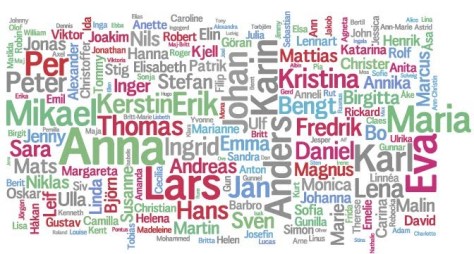
I would, for instance, have had the family name Dalkesdotter, since I am the daughter of Dalke. My brother would acoordingly have been called Dalkesson. During the 23 years I have been teaching I have noticed the change in naming. When I graduated in 1991, many of my first students had names that have been used in our country for generations. Boys names like Daniel, Peter, Mikael, Anders and girls names like Anna, Maria, Kristina, Helena, Ylva etc. But after a few years of teaching I noticed that many of the boys now rather had names like, Kevin, Justin, Jim, Tim, Tom and girls had names like Natalie, Felicia, Caroline, Nellie etc. Nowadays we find a lot of different names, a variation that can be connected to our complex world with input from not just the local area, but from other parts of the world.
namnbild.jpg (672×361)

My own name, Åsa, is from the time before Sweden was Christened and means ”goddess”. Very few little Åsa’s are to be found nowadays, but instead some of the names that I would connect to old relatives are coming up as new favourite names for kids. It’s funny how one sometimes hear parents call for their little ones and you expect a person in their seventies to approach behind a tree in the park, but instead a little toddler, called Bosse or Leif, will meet his Mom with a lovely smile!

toddlerRoundup-14.jpg (600×503)

My friend the archeologist from the mountain top is a very good example of being modern at the same time as he cherishes the value of how our ancestors chose to live their lives. What footprints or fingerprints will our generation leave? No mountains will be filled with names, but maybe we will share something else that is just as interesting and important? Let’s hope so!

Welinder, S (1992) on Skrivarhällen i southern Dalarna, Bergslagen, Sweden