Two Hundred and Sixty-Forth Asic- School Smart with Smart Phones?

A lot of facts can nowadays be easily found on the internet. Rote learning as it was when I went to school, will soon be forgotten and a five-year-old can google just about anything with no help from an adult. I sometimes feel old when I notice how my kids know things I spent a lot of time learning. I do however think that the young generation of today are lucky to be able to browse all these facts and photos and movies and easily finding out about things that took a very long time when I was a child. They can even find friends abroad and getting to know a person on the other side of an ocean, speaking with that person in real time through computers and smart phones and I can’t help remembering my pen-pals in other countries and how I used to wait for days and weeks for their letters back to me… 🙂

All the kids nowadays need to do is Google… At work I notice that the gap between those who know how to handle IT and those who do not is increasing. There will be no equality unless students get their computers thru school and also good instruction from skilled teachers. There will always be students with parents who either cannot afford a new computer, or maybe don’t understand to what extent their kid will be left out in school if they cannot be online and use internet as the rest of the kids. Being curious is a good start!

Even if we may think some things were better THEN than they are NOW, we need to at least try to go with the flow…

Otherwise we, the teachers, would soon be relics, too… Stored and filed side by side with flanellografs,

chalkboards and sandpits with sticks…

griffeltavla.jpg (637×510)

In subjects where a smartphone is a rich resource I don’t fully understand why schools still say students cannot use their phones in class, but I assume it’s a matter of students’ age. The teacher has a great opportunity getting things done a lot more easy by accepting the use of smart phones when it IS smart to use them. If I would stick to the rules of many classrooms today and say ”Don’t use your smart phone in class!” my students would have a tougher time learning Swedish. I do however need to stress that one of the reasons for smart phones to be a good alternative in my classroom is the fact that I teach adults. My subject is Swedish as a Second Language.

I have experience from working with teenagers or younger and having to address several situations each day where students have passed rules for the usage of their smart phones. Not all students respect rules and when students end up in recordings or photos that are posted on the internet that is a problem that takes a lot of important time off from the learning process in class. One way of dealing with problems such as that, is to remove the actual smart phone from the classroom situation. In many Swedish schools teachers collect the students’ phones before each lesson, in order for students not to use them in class. Thus the students are more focused on what their teachers say and what the lesson is all about, which is of course very important. I do however think that it is sad that such an extraordinary tool as the smart phone cannot be effectively used for learning purposes. If it’s a matter of disciplin, then the actual disciplin problem needs to be addressed. From here and on, this blog post is focusing on some of the benefits of using smart phones in learning situations.

Let me share a few examples from my own classroom, which is a language learning classroom with Swedish as a Second Language as the one and only subject. When we don’t find the solutions to meanings of words, the smart phones serve as dictionaries and saves a lot of time, compared to finding out by a visit at the local library, but that is not the only way to save time with a smart phone in a classroom! The students and I talk a lot about things we read, listen to or watch. I always try to help them by writing additional examples on my white board. This is however not a classroom with a SMART BOARD, but just an ordinary poorly equipped in-the-basement-classroom. When the white board is completely filled with comments, words and phrases connected to the topic we discuss,  I ask the students to simply use their smart phones and take a photo of my notes. That’s quick and easy and also a SMART way to use PHONES, although in the future,  I hope to be among the lucky ones who have smart boards in their classrooms.

Another thing with language learning is to use the phone for pronunciation. Many students in my classroom merely meet one person who speaks Swedish and I am that person. Although I try to give them several suggestions to where they can listen to Swedish, or perhaps meet Swedish people and talk to them, it is very difficult for some of them. Their smart phones is thus an excellent way to help them out with at least pronunciation of difficult words or phrases. More than anything else, the quality of the sounds of the nine Swedish vowels, when put in different positions of words or phrases are easy to repeat when students get back home, if they have recorded different examples in class. When students record my pronunciation and go back home and listen and repeat, their own pronunciation improves rapidly.

Ines Uusmann, Minister for Infrastructure, seemed to believe that the internet would be forgotten after a few years, although it is said that the reason why everyone remembers, is that the headline for the article was a fake quote. This is in fact (in Swedish, though…) what she said:

”Jag vågar inte ha någon alldeles bestämd uppfattning men jag tror inte att folk i längden kommer att vilja ägna så mycket tid, som det faktiskt tar, åt att surfa på nätet. […] Att sitta och surfa på nätet tar en himla massa tid. Vad är det bra för? […] Det kanske är så att det är något som vuxit upp nu. Alla pratar om internet men kanske är det övergående och sedan blir inriktningen mer specificerad”

Ines Uusmann citerad i Svenska Dagbladet, 12 maj 1996.

Källa: Rydén, Daniel, ”Dimmor på nätet”, Sydsvenskan, 4 mars 2007.
 

Tvåhundrafemtiofemte åseriet- Att jämföra

Att jämföra två objekt med varandra, innebär fler svårigheter än man kan tro, åtminstone för den som studerar ämnet svenska som andraspråk. Vilket språk vi använder när vi jämför kan vi till exempel läsa oss till i olika handböcker och även om handboksförfattaren har vinnlagt sig om att förklara systematiskt och noggrant, så kan det ändå vara så abstrakt formulerat att det leder till att eleven ändå inte förstår. Därför brukar jag försöka kombinera flera olika sätt att förklara, för att så många som möjligt ska kunna hitta sitt bästa sätt att förstå. Ofta hittar jag dessutom utgångspunkten till lektionen på något oväntat ställe. Den här gången var det ur Vi i villa, men lika ofta är det ur reklamblad eller i vanliga dagstidningar. Vi har så mycket språkbitar runt om oss som också behöver förklaring, att det verkligen inte är något problem att hitta utgångspunkter. Möjligen är det svårt att sovra…

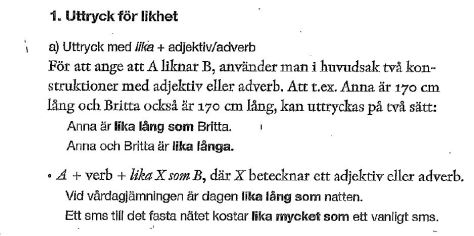
Dagens lektion om just jämförelse började därför med en genomgång av en handbokstext, som inte alls var speciellt lättbegriplig, men som i stället var noggrant systematisk. Exemplen i handboken var konkreta och tydliga och därför tipsade jag eleverna om att fokusera mest på exempelmeningarna utan att stirra sig blinda på de märkliga definitionerna som innehöll X och Y och närmast påminde om matematiska definitioner. Precis som jag misstänkt, fanns ändå i klassen några som tyckte att det matematiska upplägget var väldigt tydligt och bra, medan andra snarare värjde sig för själva definitionen, men utan problem förstod principen genom att studera exemplen. Från s 304 ur Garlén och Sundbergs Handbok i Svenska som andraspråk:

Ur Garlén och Sundberg_Handbok i Svenska som andraspråk

När vi något senare jobbat oss igenom handbokens beskrivningar av även skillnader, ville jag ge eleverna verktyg för att kunna jobba tillsammans med en jämförelse-övning senare. Därför ägnade jag mig åt att först hjälpa dem med ett antal ord och uttryck som de skulle behöva för övningen. Jag valde att utgå ifrån en sida ur tidningen Vi i villa (2014) som jag sparat just för att bilderna har så tydlig koppling till just temat jämförelse/likheter/skillnader. Jag ville först ge eleverna möjlighet att diskutera ”vilken bild de syftade på” och pratade därför med dem om raderna som första, andra och tredje raden, men förklarade även att man precis lika gärna skulle kunna säga ”på översta raden”, ”på den mellersta raden” eller ”på den nedersta raden”. Sedan pratade vi om andra liknande uttryck som också behövde komma upp till ytan just idag… till höger, till vänster, andra från höger, längst ut till vänster, i högra hörnet…i kanten…

Att jämföra

Sedan började vi prata om själva jämförelsen av grindarna på bilden… Jag bad eleverna föreställa sig att de skulle komma till byggmarknaden för att köpa en grind eller att de kanske arbetade där som säljare och skulle hantera den beskrivning en kund skulle ge av en specifik grind. Vilka typiska kännetecken har den enskilda grinden? Är den smal eller bred? Hög eller låg? är den enkel eller dubbel? Har den handtag och lås eller kanske enbart det ena? Är den enkelt utformad eller har den en rik ornamentik? Är materialet trä, stål eller smidesjärn? Finns det intressanta mönster som går att beskriva? Är den obehandlad, tryckimpregnerad eller är den vitmålad? När jag leker med den typen av övning i klassrummet, ger jag först alla ord man kan behöva, men sedan kollar jag snabbt hur mycket som fastnar, genom att be någon beskriva eller använda de helt nya uttrycken. Det handlar om det proximalt lärande (Vygotsky) och min erfarenhet är att det brukar ge tydligt och snabbt resultat och även eleverna själva känner att de lär sig nya ord och uttryck.

IMG_2030 (2)

Det jag redogjort för hittills är själva upplägget, undervisningen, innehållet… kalla det vad du vill. Efter detta är det snarare så att elevernas arbete återstår… De får en ANNAN uppgift att jobba med, men nu kan de använda sin ”ram” från den första tavelbilden här ovanför. De arbetar i par. Den ena i paret har ett A4-blad med femton bilder av personer, ordnade i tre rader, med fem i varje. Den andra personen i paret har en ”kortlek” med samma bilder, men i oordning. Personen med kortleken beskriver sitt första kort så pass noga att det går att hitta just den personen bland de femton bilderna på A4-bladet. Nu är det upp till kamraten att använda sina uttryck från min undervisning: ”Jag tror att du menar personen som är längst ner i vänstra hörnet” eller ”Jag tror att du menar personen som är på den andra bilden från höger på tredje raden” etc. Förutom att lärandet sker effektivt, så brukar elever tycka att det är ganska roligt också. Man fnissar åt varandras försök att beskriva eller bjuder på sig själv när man misslyckas med att förklara och i den där aktiviteten är man så pass ”här och nu” att lärandet sker av bara farten. Det är lätt att lära om man samtidigt har kul…

Den där första texten ur handboken då? Jo… När eleven kommer hem igen, med dagen i backspegeln, så går det lättare att förstå även den abstrakta svenskan och de märkliga formlerna, för nu har man tränat på något enklare, som går att förstå.

Twohundred and Fifteenth Asic- A Day to Remember

I sit in my classroom, monitoring my students writing an essay. Since my students write in a language that is not their first language, I thought it fair to do the same… I write in MY second language, English, when they write in Swedish… Here’s my text on the topic ”A Day to Remember”, but I guess in my example it will spread over more than just one single day:

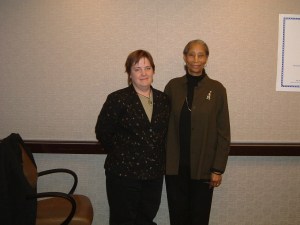
It had been a tough start filled with unexpected events and flight delays, but one memorable Monday morning in October 2003, I met up with the others in a group of Swedish teachers who had the great opportunity to meet the legendary principal Dr Lorraine Monroe for a four-day-long conference about School Development, Instruction and Teaching in NYC. During the flight I gave Dr Monroe a thought. What would she be like? According to her book, Nothing’s Impossible, she had first worked as a teacher, then she had become a principal, changed the way of teaching and instructing in her actual school and that had, in the long run, led to overwhelmingly good results in schools in Harlem, New York City. Dr Monroe’s ideas about school development were very focused on learning and in a way very strict and not at all negotiable ( Please read Dr Monroe’s book for more information!).

Nothing's impossible

We have a very democratic way of teaching in Sweden. We ask our students for their opinion in many different situations an ordinary day in school and lessons often has an element of discussion or mutual understanding. It is not meant to be a one-way-communicated ”lecture”. Learning is a joint effort…  At the time when I was in NYC I was taking a University course and thought it might be suitable to interview Dr Monroe for my project. She accepted and that was probably ”THE” most interesting talk I have ever had with anyone about ”teaching and instructing”… But let’s go back to the first meeting… The skyscrapers on Manhattan were taller than I had expected and being in NYC was fantastic! Meeting Dr Monroe in person was way beyond every anticipation I had before. She was, apart from being intelligent, also a born entertainer, wittily telling jokes. The conference was of high quality and we met brilliant teachers, devoted principals and engaged counselors from different schools in Harlem NYC. In comparison with the interesting lecturers, Dr Monroe was still outstanding. 

We made a few visits to schools in Harlem. I thought I’d check one of the things that Dr Monroe had said the day before. She had claimed that in her schools I could ask any student I liked if they could answer the question ”What did you learn during the lesson you just left?” Every student I asked, could share with me what they had learnt and since we had monitored the lessons the students were referring to, we could tell that they actually learned. The other teachers in my conference group had the same experience and we said this would be the first thing to ask our students back home! I think many students in the classes I taught back then would answer ”I don’t know… What do you mean? What did I learn??? I don’t understand your question!” At that point in my career, in 2003, I didn’t understand how important a META level is in learning… Now I try to help students gather information, draw conclusions, spend time thinking and reflecting and thus allow them to understand and comprehend. After that day in October 2003 I try to keep my lessons very strict in content. I also try to wrap it up at the end of a lesson, in order to help students to organize their thoughts. The students in my classroom now will more likely have a correct answer to the question about their learning…

My interview with Dr Monroe back in 2003 again, started off with my question ”In what way do you negotiate with your students?” She seemed to be hooked on my QUESTION, as if it was wrong… and repeatedly said ” I don’t negotiate with my students!” I thought, being Swedish and speaking my second language, that I had said something that was difficult to understand… Therefore we had a long interesting chat about what the WORD negotiate meant… Obviously we both agreed on the meaning of the word, so I again asked my question, but surprisingly enough still got the same reply! Later on, after half an hour of discussion I understood… I had taken for granted that  of course Dr Monroe did negotiate with her students, but HOW?  But, the point was taken. She actually did not negotiate with her students…simply because (and she explained that) some things aren’t negotiable… 

Ever since that day I have always thought about how different RESULTS we may get in schools were ”everything” is negotiable, compared to schools were very little is… Anyone can understand that students who never ever question their teachers have a different school situation than those who constantly say to their teacher: ”Why are we supposed to to this?”, especially if the teacher is used to give such a question an answer… Dr Monroe said many times during that week in NYC: Focus on learning! The interview with Dr Monroe was an eye-opener for me as a teacher. I didn’t change everything when I returned to Sweden, but I did change a lot. I didn’t even change it into ”The Monroe Doctrine” but I did borrow a few of her ideas and I am forever grateful to her for being there in that interview and very patiently letting me understand her thoughts about negotiation (or not!) and about teaching and instruction in general. In my teaching career meeting her was absolutely A Day to Remember


The ninetyfifth åsic- The Yellow Wall and The Blue Wallpaper

Charlotte Perkins Gilman’s The Yellow Wallpaper is an American short story read  by many, but how many of the readers have spent a fortnight of pure creative language learning in a yellow classroom ? The teacher had painted her classroom herself and turned the dark dull room in the basement into a positive oasis for learning. All walls were painted in a bright yellow colour. Her combination of gifts from previous students, her own creations or things she had got here and there, together with wisdom on little plaques or instruction posters with different themes like weekdays, phrases or words for certain occasions, gave the impression of a nice and welcoming place where the soul of learning was more important than anything else. Soul in English almost sounds like sun in Swedish, sol.

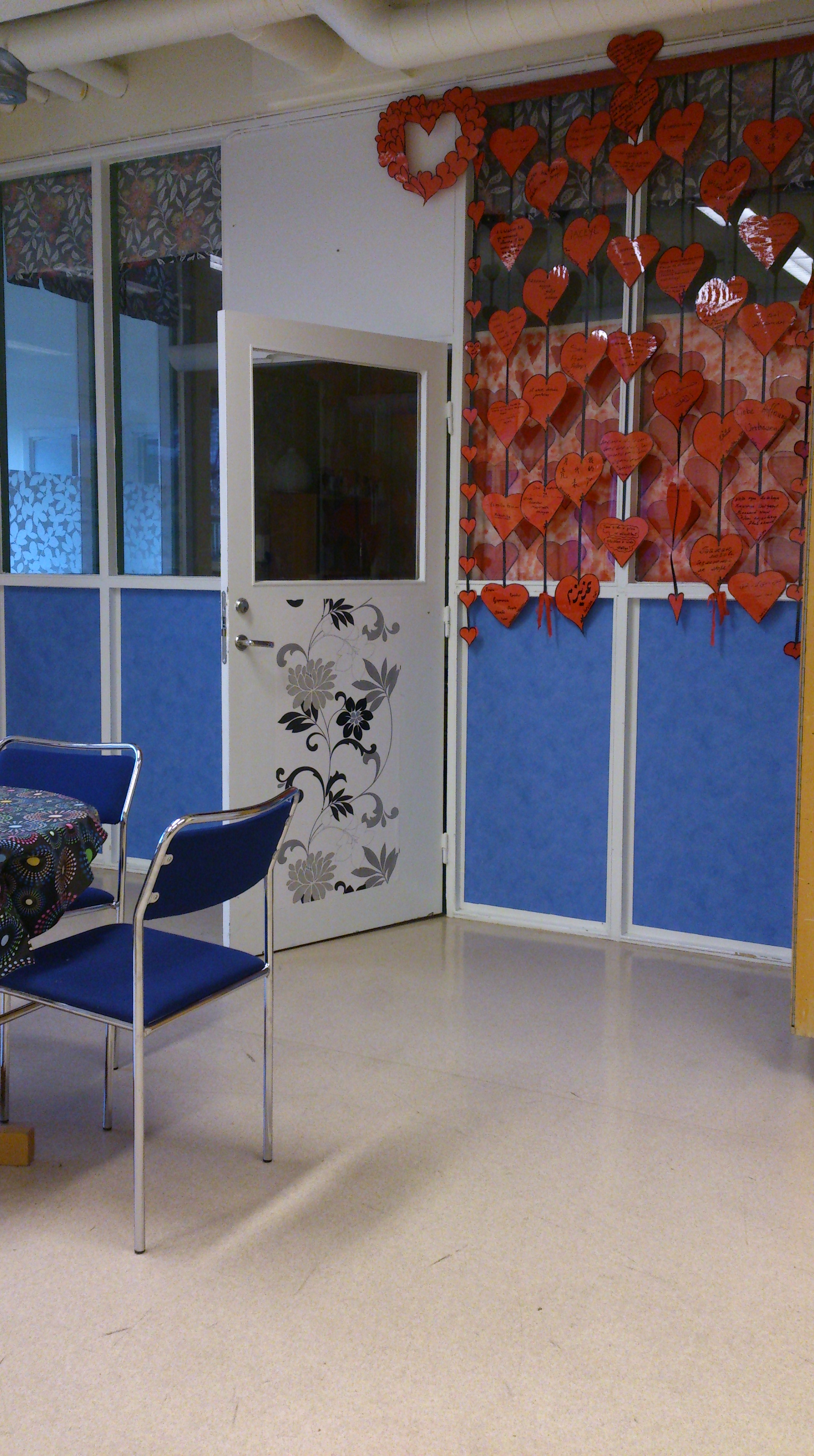
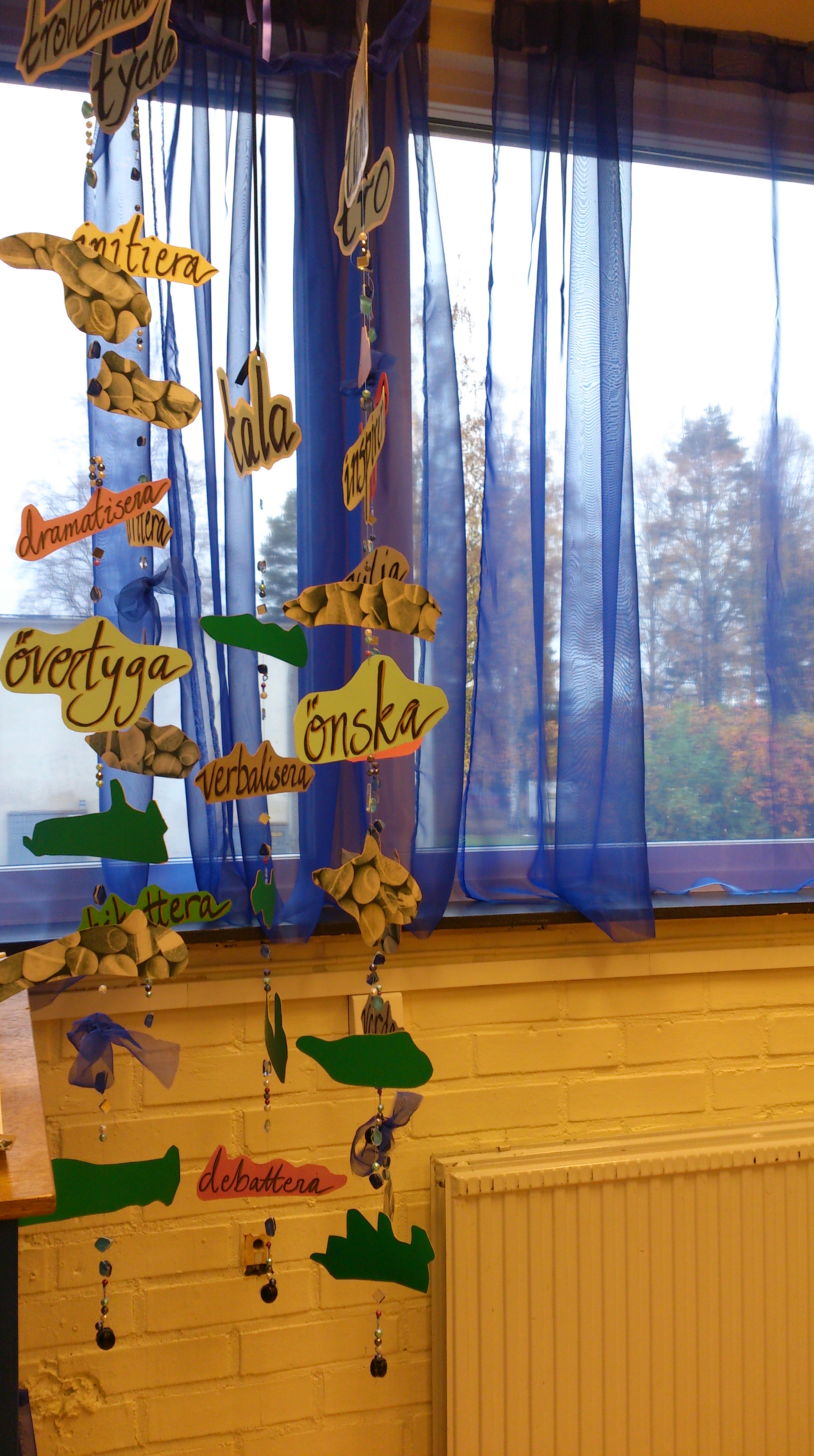
My classroom is not painted by me and it is not yellow either, but I have hanged The Blue Wallpaper myself and I have added a lot of blue accents, such as glass, fabric or decorations. Blue is my fave color and it also lead my thoughts to water or to a realxing feeling that makes me calm. In one of the corners of my room I have a waterdoor… In another corner are verbs connected to language use. The many hearts on the window to our pentry is decorated with thoughs or words on the theme LOVE. I think my students are important in many ways. I also find their background, culture and languages important. I think it is necessary for a classroom where languages are taught, that you actually can see that we speak different languages. All those languages are important. Knowing several languages is a true wisdom!

BLÅTT och GULT

 DSC_0016DSC_0017DSC_0015


The teacher I visited was teaching about weather expressions in Spanish when I was there and both the students and herself were happy… and yellow is the happy color that perfectly suits a classroom for Spanish lessons. A saying by an ”unknown” author that suits the yellow classroom very well:

Keep your face to the sunshine and you cannot see the shadow

The ninetieth åsic- My New Favourite Tree

Quercus_rubra_1.jpg (582×671)

For a couple of weeks I have had the opportunity to experience a very mild and nice autumn here in Pitman, NJ. One of the days we had +28C which is not at all like the temperature for October in Sweden. In my 71st åsic(#Sjuttioförsta åseriet), I wrote about the maples in Sweden and how I used to collect the colourful leaves in the autumn. I have always loved trees and since I live in a part of Sweden where forests are a part of the nice scenery, I always find a walk in the forest very soothing if I need to relax or find new energy. I have walked along nice streets here in Pitman, where mainly tall maples and oaks give gardens their share of fallen leaves. One kind of the tree was unfamiliar to me, but I could tell from what it looked like that it had to be a maple or an oak, so I picked up a leaf and brought it with me to #Pitman Middle School, where I asked everyone I met: ”Is this a maple or an oak?”. Most people said: ”I don’t know but I think it is…” and then two people very quickly said: ”It’s an oak, no doubt!” Now I KNOW it is an oak, since I have done what most people do nowadays… I googled it… It turned out to be a red oak.

The fallen red oak leaves has the same SOUND as the fallen Swedish maple leaves when you walk through them… The other day I took a shortcut home and ended up very far away from home in an empty yard…learning that just as ”genvägar är senvägar” , shortcuts tend to be longcuts…

One good thing by taking the ”shortcut” was that I had to walk on a narrow path in a little forest, passing a railroad to get back home. The fallen leaves in a thick layer sounded like the maple leaves from my childhood and around me both squirrels and chipmunks ran about. I knew I was very close to houses, but the trees and animals made me fly away in thoughts for a while. The beauty of coloured leaves is still the same, no matter where I am. It gives me a feeling of gratefulness to see all the colours, hear the dry sound of the leaves as I walk through them. The sunrays hardly pass through to the ground and there are merely dark soil and old leaves for the squirrels to run about in. In its lack of colours, the ground already seems ready to meet the winter. In my lack of inner compass, I also seemed ready to meet the winter… Luckily I made a correct guess and soon found my way back to Broadway again…

Det hundrade åseriet/The hundredth åsic- A Moment 22 for many teachers

In 1992, I started off as a class teacher of twelve-year-olds in grade six. My exam covered Swedish, English and the four different subjects that are called ”SO” in Swedish, i.e, Geography, Social Science, History, and Religion. I was supposed to teach grades 1-7 in the Swedish Compulsory School System.  In 1992, it wasn’t unusual for teachers to teach both subjects they were skilled for as well as subjects where they didn’t have any exams. In my case my first job as a teacher was a position as a ”class teacher” with both Math, Science and Art. You may think:

”So what? If you have graduated, it doesn’t matter what subject you teach!”

I strongly object to that point of view. It DOES matter! First of all you need more time to prepare lessons properly in subjects where you have no academical skills or grades. Secondly you may not find suitable examples for students to understand complex structures or important details. Students who need extra attention from the teacher in order to ”get it”, would be better off with a skilled teacher in Math, rather than a teacher in Swedish, who tries her very best.

A Moment 22

The subjects you love most of all, will be neglected since you need to make an effort and focus on subjects you didn’t even want to teach in the first place. The estimated time for planning of lessons will be up when you start planning for your own favourite subjects.

An ordinary day when you have planned all for today’s lessons and come to school early enough to have a cup of coffee with your teaching friends, you notice that your dear friend in the classroom next to yours is on sick-leave. You hope for her (it’s often a she!) soon being back, but you also realize that you will be the one to fill her position in class, ALTHOUGH you have a classroom filled with students, too… What can you do about it? Not much, really. Hmmmm… 55 kids instead of 27? What is my options for today’s teaching…? As I said, I had planned it all from the start, right? But NOW, I will have to just dump my own plan, and also probably dump my teaching friend’s plan, because I am ONE teacher with TWO classes… I HOPE that is history by now!!!

I taught in a school where our policy was to be our own ”subteachers” in a flexible system. Quality??? Excuse me… We didn’t discuss that topic much. It was more about money. But why wasn’t it just possible to find a teacher who would be in our regular staff as an extra resource? Money… Again… OK… Then if there is no way to hire a TEACHER…can’t we just find SOMEONE????

For way too long it has been possible for principals in Swedish schools to hire ”teachers” who lack the required qualifications for teaching. Qualified teachers have also for way too long been responsible for ”helping” those subteachers in their job, instead of  teaching their own students with high quality. But why complain? It can’t be that difficult to help a friend who know nothing about teaching, right? No, not if it would be ONCE or maybe TWICE, but if it’s the rule rather than an exception, then it’s not fair at all. It is unfair to the students, both in my class and in the class where the subteacher works. We are all losing focus from our ongoing learning proccess.

A possible scenario

You rush into your own classroom, inform the students that  you will have to start a lesson together with a subteacher in the nextdoor classroom and will be back soon. Then you help the subteacher to find books or material, tell the students to help the subteacher as much as possible, also inform the subteacher about students with special needs, such as diabetes or epilepsy. You also try to write a short list of important details, such as at what hour you take a break, when students leave for PE, or when lunch is served. In some schools there is a binder filled with ”all a subteacher needs to know”, but despite the binder, many subteachers may either not have time to read the information, or are completely new to teaching and have never been in this particular school. Sometimes they are 18 years old and lack every experience there is to ask for. You help this person the best you can anyway, because you know it will turn out for the worse if you do nothing at all. Luckily, many subteachers have been teaching for a long time and also know the students in a few schools in their local community quite well. Then the options for a win-win-situation is a lot better. OK…It’s time to rush back to your own class and start off what you had planned for! Guess what? The students haven’t started doing what you asked them to… Instead you need to re-start the activity and sometimes you will have a hard time getting every student’s attention again. When you finally think, ”Yes!” and your class seems to be focused again, you hear a knock on your classroom door… The subteacher needs more help…

The results for Swedish school children in PISA and other international tests have never been as poor as the last few years. In my opinion it is possible to explain the failure as a misuse of resources and a slow motion in change or maybe blame the many changes in our school system. When will there be time to focus on learning again?

I am happy to say that I rarely hear about problems like these nowadays. I am also happy to say that some of the subteachers I have been teaching side-by-side with were really nice persons who did a wonderful job. A certain blonde whom I tried to persuade to become a teacher, instead decided to become a nurse. The lucky patients know who I mean! 

 sjukhus_91762714.jpg (380×230)

One hundred and fiftyfirst åsic- February at its best?

Being a teacher means planning ahead of time and trying to find as interesting topics as possible for one’s students. I try to combine both methods and genres with something that students may find useful for the moment. One such topic that I keep working with every year in January and February is winter.

Cherry Covered in Winter Coat

My adult students may sometimes come from countries near ours, such as the Baltic countries or maybe Germany or the UK, but most of them don’t. Instead they started their lives in a country far away from Sweden, where there is no snow and where the Swedish winter may seem both everlasting, too cold to be outdoors in, dark and difficult to deal with. I try to find texts that are very different. There are lyrics from songs on winter topics, extracts from books, short stories, movies, chunks of news, weather reports as well as newspaper articles of different kinds.

Does it matter what whether it is outdoors to talk about winter? I’d say I have been lucky this year, since the weather has been very varied. I had the opportunity to talk about extremely cold weather and the words connecting to glistering snow, as well as the boring cloudy skies in a slushy morning when the ploughmen have not yet driven by… I have also had the chance to share with my students some of the typical winter songs or words one may need to label typical winter activites.

It doesn’t matter what the weather is like. The more varied it gets, the better for my purpose at school! Using here and now as a resource for teaching makes learning more hands-on for students. Students find their learning meaningful if they can use their new vocabulary already on their way home from school. Who wouldn’t? Learning things that are supposed to be put away for later, tend to be boring very quickly, whereas useful phrases and vocabulary for instant use makes the effort worth while.


(adsbygoogle = window.adsbygoogle || []).push({});

Seeing is believing

I have noticed in my own teaching that the students who DO watch my face find their correct sounds in Swedish easier. If adding on comments on what I do, I help them even more. I talk about how I form my mouth compared to similar sounds in for example English, a language many of my students know quite well, but with completely different SOUNDS. Read below to find out more.

Seeing is believing.

One hundred and fortieth åsic- The Impact of the Principal in the Process of Change

I remember a very interesting situation in my teaching career when the teachers in the school where I taught at the time, had worked together in smaller groups, with the only instruction to ”find a way to work more efficiently with the new curricula”. The groups may have been three or four. Every group consisted of teachers not only from school years 1-6, but also from the very new ”preschool class” level and from nursery school with children at the age of 1-5. The mix of teachers in each group, made it more difficult to find general solutions where every group member was satisfied, but on the other hand, all groups came to the conclusion that the very process was important as a way to understand in what way teaching could be the same or completely different when comparing one setting with another. All groups also noticed that the very process created a more close relationship between the different teachers involved. The bonding and feeling of being a member of a group with a mutual idea of how this very school could change, made a tremendous impact among the teachers.

Changing-Directions.jpg (850×565)

They felt more professional, more engaged and interested in educational development. Most teachers took their time listening to each other, both to experiences of teaching, but they also listened to ideas, new input that they themselves had not tried before. The principal at this school was very engaged, too, and after a while, the whole school seemed ready to form a completely new organisation. Many of the teachers could see a very interesting learning environment take form and where thrilled to go on with the process.

The new thing at this time in this particular school was to split up the original groups and classes vertically rather than horisontically. So far this school had taught groups of children born the very same year. According to the new idea children would follow a certain path or track with mixed ages within the group. The students would thus be in groups with not only children who were born during the same year, but also with both younger and older children. Teachers specialized for a certain age group would be working with teachers focusing on other age groups than they did themselves and the idea was to create an enrichment for all involved, both students and teachers. 

When the idea with tracks was fixed as a new organisation to come, the teachers met a new challenge in planning for the work in each ”track”. Those who would be teaching the very same children planned for their own track and now they needed to focus on questions like ”How?” and ”What?” and ”Who will be responsible for this or that?”. A new frustrating, but also interesting process started, where members of the groups  tried to communicate what would be ”the very best solution” for their ”track”. Interestingly enough, the different groups found very different ways to work. None of them was ”bad”, but just ”different”, which every teacher in this school agreed upon. When they all met to share the results of the group level work. The good ideas were collected and shared between the groups. They all felt prepared and eager to start the new school year.


stopp-hand.jpg (390×517)


Guess what????


This school then changed principals and the new principal simply said: ”The idea with tracks is not  my cup of tea. Let’s stick to the old organisation and cancel the change!”


I’d say this is typical for what it is like to work in a school in general… A principal starts off a change and his staff more or less reluctantly give their engagement and hard work to make that change possible but another principal won’t continue the process and the staff is left to just follow new orders but still enjoy the every day work to the same extent. It seems to be the same thing on a national level although it is supposed to be groups from different political parties who deal with long term changes in our school system. Why else would the School System change every time we change Governments?

lampa.jpg (768×1024)


To be a teacher means working in a constant change. It goes on and on and has no end. We all know that. We meet new groups of students, we teach new content to new age groups or we meet new teaching friends whom we are supposed to work in teams with. We all understand we need to be flexible since everything else would be an obstacle to the whole educational system. But having said that, it would for sure help both teachers and students if changes would always be based upon scientific results, rather than a single person’s bright idea. It would also, for sure, be great if we could get some peace and quiet and a chance to focus on students’ learning.

If you are interested in a more general blogpost, then please read the #one hundred and thirtyninth åsic.