Twohundred and Seventy-Eighth Asic- Anticipating Summer Vacation makes the Month of May seemingly Endless…

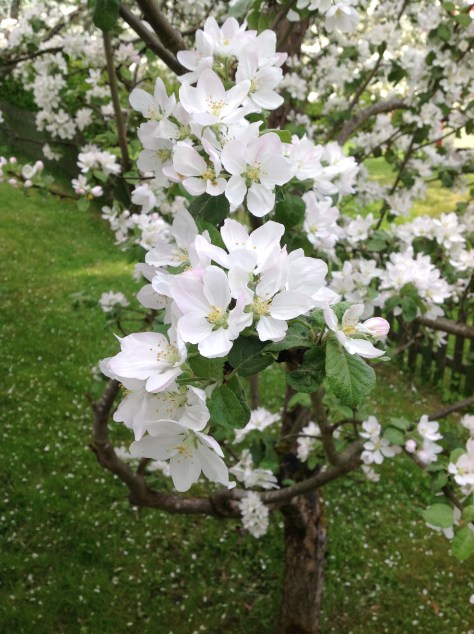
Apple Blossom

It’s not over yet, one more week to go before the Month of May has come to an end… It’s funny how this month is connected with an everlasting workload at work and a fantastic bloom everywhere I lay my eyes… Apple blossom, flowers, the scent of Lily of the Valley when I pass my neighbor’s garden…

In Sweden where I live, we have the wonderful Nordic Light to support us when we feel tired this time of the year. Somehow I don’t really get tired, but a workload of grading at school makes me exhausted to the limit of what I can take in my profession. I have however noticed as years pass by, that I always manage to hand in all the grades in time, send out the papers to the students and clean my desk at work before I leave for summer vacation.

Added this year is our moving to another building. The four teachers in my staff room are now packing up our things and that is a bit sad. We have had a nice time together.  Personally, I have enjoyed my current position and classroom, too. But honestly, I know that wherever I move with my teaching, I have always enjoyed it, once I’m settled in the new place. What I DO mind a bit is the disorganized chaos before everything is set…but I guess I’ll have to live with that for the time being. It’s just a matter of days…:)

One month from now, I’m already on summer vacation, thinking of the past school year, hopefully with both satisfaction and a bit of loss, just as always on a sunny summer’s day!

#klocka


Twohundred and Seventy-Third Asic- A World of Language Learning Starts in Your Computer

Londonbild 1_OLÅ

I’d like to share with you how learning can become interesting to young students if focus on learning derives from questions raised by the students rather than the teacher. I was teaching a mixed group of students in grade four and five in the Swedish compulsory school system. The students all had very few contacts with native speakers of English or with students from other countries. I wanted them to improve both their written an oral English and thought of different ways. It was in the middle of the annual summer vacation and as usual I spent time thinking of the coming school year. Isn’t that typical for a teacher? I know I’m not the only teacher who spends time planning for future teaching while their off of school.

Anyway, I thought of the idea of getting some kind of pen-pal for each and every one of my students. At this time I had just got my first personal computer through work and I wasn’t very familiar with how to use internet as a resource. I was therefore searching for different websites in order to find addresses to PEN-pals. It wasn’t until I came across the website http://www.epals.com with the very new word #epals, that I realized that PEN-pals were completely outdated! I was thinking like a dinosaur! Briefly, ePals is a website where teachers or students or for that matter teachers AND students can get in touch with each other in order to collaborate in different projects. It doesn’t have to be international projects, but in my case it was.

From the start I didn’t plan to collaborate at all with any American teachers. I was focused on the UK, since I was going to the UK in September in 2000. I spent a couple of hours reading different profiles in the ePals website and then I wrote my own profile. Already while I was browsing the site, I got a few mails in my inbox. There were two of them from American teachers and one of them was from a British teacher. They all seemed very nice, but since I was in a hurry to get my project going, I wrote to the British teacher, telling him about my plans to go to the UK and I also fired off my question about the two of us meeting each other to plan our future collaboration with our students. I wrote “Since I come to the UK in September, I hope we can meet and plan for our mutual project!” Then, since I was in a hurry and also because I know that teachers don’t like to spend time doing the wrong things, I wrote back to the two other teachers politely telling them that unfortunately I had already found a teacher in Britain whom I wanted to collaborate with and thus I didn’t need to write to them…

The “British” teacher replied to my email saying something like “It’s not that I don’t WANT to meet you, but how exactly did you think we could meet if you go to the UK and I live in New Jersey?”
Anyone who gets an email with that comment could have given up, but I’m not that kind of person. I wrote back. The “British” teacher wasn’t at all British and the REAL British teacher, whom I mistaken for being American, was of course already lost and gone, so what options did I have??? I started off brushing up my own English, by writing back and forth to this particular American teacher, who seemed to be a nice person already from the start. He was a teacher in a class in the same age span as my students, so after a few weeks of planning we started off writing emails between the two different schools.

At first, we instructed our own classes to write more general letters about themselves and share photos and details about the school system or what the school looked like. But gradually as the students got to know each other a little better, they started to ask their own questions and compared the learning situations in Sweden and New Jersey. My students, who were used to several breaks during school days, were shocked to notice that the students in the American school had fewer breaks and also lacked a nice lawn and a playing-ground at school. Outside the American school was instead a parking lot.

There were a lot of similar topics that gave students in both ends of our mutual collaboration a chance to challenge their language skills. In the American end students had a more cultural based viewpoint to our project, whereas in Sweden the focus was mainly on language and how to express oneself. One thing lead to another and the American teacher and I also visited each other’s schools and got the opportunity to see through teaching what it was like to teach in a completely different school setting than the one we were used to, respectively. I remember from MY teaching during one single day in the American school, that it was weird to be addressed Mrs Olenius. I also found it interesting to interact with the student in MY way, rather outspoken and joking, and notice how a few of the American TEACHERS frowned. It seemed to me as if they were taking their ROLE as teachers much more seriously than I do, which was interesting to note.

Later, my American friend visited me and my class in Sweden. He had brought with him a few interesting lessons to teach and one of them was in Physics, where he wanted to show the students how an American Hurricane builds up, by using two large bottles that he quickly moved in order to make it seem like a hurricane inside the bottles. An interesting thing with his experiment is the obvious difference between the ways we would do such an experiment and the way he did. He ended up getting eager students around him who wanted to do the experiment themselves, not just look at him doing it. In Sweden I’d say most teachers would give their students the opportunity to try out such an experiment by themselves. Another thing the American teacher probably noticed is that his usual reference to the famous Wizard of Oz didn’t work in Sweden. Why not?

A Swedish student in grade five generally wouldn’t know what kind of movie that is.
I’m happy to say that this American teacher and I have been friends for a long time now and thanks to him, I have learnt a lot about America that is more positive than I could ever imagine. Maybe it was meant to be that I mixed the American teacher with the British?

Vemvet

Twohundred and Sixty-Fifth Asic- Fifteen Thousand Views

wordle_OLÅ_4

Today this blog reached 15,000 views!

Thanks for reading! 

Two hundred and thirtyeighth asic- Kids vs Dinosaurs at Natural History Museum

Journey to the Centre of the Earth

Journey to the Center of the Earth, just like in Jules Verne’s book…

When entering the magnificant Natural History Museum in London, you virtually end up in the Center of the Earth… and when you reach the first floor you have a great opportunity to understand natural forces such as volcanoes and earthquakes and how rocks erode into pebbles and sand. When we walk through the many displays we comment on the fact that behind every single display hours and hours were spent in collecting facts, building suitable models by various materials, trying to explain to the visitors how things work… I think the very difficult topics in Natural History Museum were very well described and easily understood, both for adults and kids. That is a fantastic help for all the visiting teachers, since they can thus walk through the displays with their classes in a more relaxed way, trying to answer the many spontaneous questions they get from their students walking through . There were plenty of fantastic hands-on-displays and charts and maps of different kinds. A fantastic experience  for both teachers and students!

Oak leaves

Whatever adults think of dinosaurs, I know from my years of teaching young kids, that the long lost creatures are very popular for some reason. Why is that? I think one reason may be that they can be compared to the dragons we get to know through children’s stories and old fairy tales. Maybe kids also use their imagination more than we do and picture themselves walking around on earth at the same time as dinosaurs?

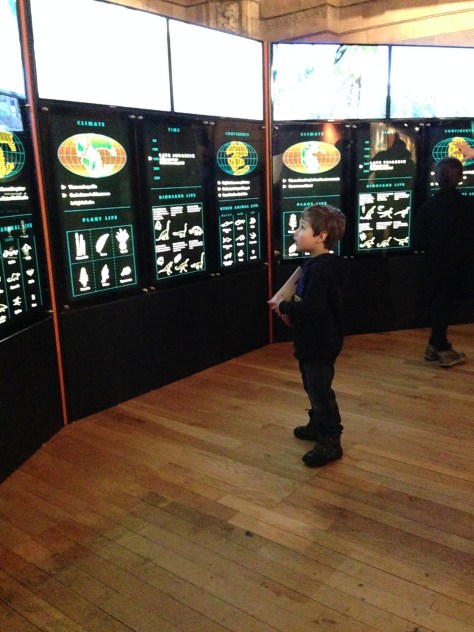
When visiting the Natural History Museum in London one thing that struck me was that it was crowded with kids…

Being a teacher off work among kids who learn is very interesting. I tend to follow closely behind trying to eavesdrop and also finding ways to see what they see…

Young audience at Natural History Museum

A dinosaur come's alive...

I remember twenty years ago when I taught an eight-year-old boy who told me all there was to know about dinosaurs. Despite his young age, he could hold a lecture about them, what they looked like, when they lived etc. I tried to keep up with him and borrowed books in the local library, but whatever I found there, was already known to him. I think books about dinosaurs may be the solution for some children’s reading problems… If they are eagerly trying to learn more about their favorite creatures, it may be more interesting for them to read an adapted fact book than to read anything else.

The very realistic looking dinosaurs at Natural History Museum serve the imagination and help many teachers, too, since they have a chance to explain very difficult things with the help of models and pictures and the many displays everywhere in the museum.

An area where we saw many students and teachers were where they kept the stuffed mammals.

A learning environment

A learning environment

Stuffed Mammals

Stuffed Mammals


Twohundred and Fifteenth Asic- A Day to Remember

I sit in my classroom, monitoring my students writing an essay. Since my students write in a language that is not their first language, I thought it fair to do the same… I write in MY second language, English, when they write in Swedish… Here’s my text on the topic ”A Day to Remember”, but I guess in my example it will spread over more than just one single day:

It had been a tough start filled with unexpected events and flight delays, but one memorable Monday morning in October 2003, I met up with the others in a group of Swedish teachers who had the great opportunity to meet the legendary principal Dr Lorraine Monroe for a four-day-long conference about School Development, Instruction and Teaching in NYC. During the flight I gave Dr Monroe a thought. What would she be like? According to her book, Nothing’s Impossible, she had first worked as a teacher, then she had become a principal, changed the way of teaching and instructing in her actual school and that had, in the long run, led to overwhelmingly good results in schools in Harlem, New York City. Dr Monroe’s ideas about school development were very focused on learning and in a way very strict and not at all negotiable ( Please read Dr Monroe’s book for more information!).

Nothing's impossible

We have a very democratic way of teaching in Sweden. We ask our students for their opinion in many different situations an ordinary day in school and lessons often has an element of discussion or mutual understanding. It is not meant to be a one-way-communicated ”lecture”. Learning is a joint effort…  At the time when I was in NYC I was taking a University course and thought it might be suitable to interview Dr Monroe for my project. She accepted and that was probably ”THE” most interesting talk I have ever had with anyone about ”teaching and instructing”… But let’s go back to the first meeting… The skyscrapers on Manhattan were taller than I had expected and being in NYC was fantastic! Meeting Dr Monroe in person was way beyond every anticipation I had before. She was, apart from being intelligent, also a born entertainer, wittily telling jokes. The conference was of high quality and we met brilliant teachers, devoted principals and engaged counselors from different schools in Harlem NYC. In comparison with the interesting lecturers, Dr Monroe was still outstanding. 

We made a few visits to schools in Harlem. I thought I’d check one of the things that Dr Monroe had said the day before. She had claimed that in her schools I could ask any student I liked if they could answer the question ”What did you learn during the lesson you just left?” Every student I asked, could share with me what they had learnt and since we had monitored the lessons the students were referring to, we could tell that they actually learned. The other teachers in my conference group had the same experience and we said this would be the first thing to ask our students back home! I think many students in the classes I taught back then would answer ”I don’t know… What do you mean? What did I learn??? I don’t understand your question!” At that point in my career, in 2003, I didn’t understand how important a META level is in learning… Now I try to help students gather information, draw conclusions, spend time thinking and reflecting and thus allow them to understand and comprehend. After that day in October 2003 I try to keep my lessons very strict in content. I also try to wrap it up at the end of a lesson, in order to help students to organize their thoughts. The students in my classroom now will more likely have a correct answer to the question about their learning…

My interview with Dr Monroe back in 2003 again, started off with my question ”In what way do you negotiate with your students?” She seemed to be hooked on my QUESTION, as if it was wrong… and repeatedly said ” I don’t negotiate with my students!” I thought, being Swedish and speaking my second language, that I had said something that was difficult to understand… Therefore we had a long interesting chat about what the WORD negotiate meant… Obviously we both agreed on the meaning of the word, so I again asked my question, but surprisingly enough still got the same reply! Later on, after half an hour of discussion I understood… I had taken for granted that  of course Dr Monroe did negotiate with her students, but HOW?  But, the point was taken. She actually did not negotiate with her students…simply because (and she explained that) some things aren’t negotiable… 

Ever since that day I have always thought about how different RESULTS we may get in schools were ”everything” is negotiable, compared to schools were very little is… Anyone can understand that students who never ever question their teachers have a different school situation than those who constantly say to their teacher: ”Why are we supposed to to this?”, especially if the teacher is used to give such a question an answer… Dr Monroe said many times during that week in NYC: Focus on learning! The interview with Dr Monroe was an eye-opener for me as a teacher. I didn’t change everything when I returned to Sweden, but I did change a lot. I didn’t even change it into ”The Monroe Doctrine” but I did borrow a few of her ideas and I am forever grateful to her for being there in that interview and very patiently letting me understand her thoughts about negotiation (or not!) and about teaching and instruction in general. In my teaching career meeting her was absolutely A Day to Remember


The ninetyfifth åsic- The Yellow Wall and The Blue Wallpaper

Charlotte Perkins Gilman’s The Yellow Wallpaper is an American short story read  by many, but how many of the readers have spent a fortnight of pure creative language learning in a yellow classroom ? The teacher had painted her classroom herself and turned the dark dull room in the basement into a positive oasis for learning. All walls were painted in a bright yellow colour. Her combination of gifts from previous students, her own creations or things she had got here and there, together with wisdom on little plaques or instruction posters with different themes like weekdays, phrases or words for certain occasions, gave the impression of a nice and welcoming place where the soul of learning was more important than anything else. Soul in English almost sounds like sun in Swedish, sol.

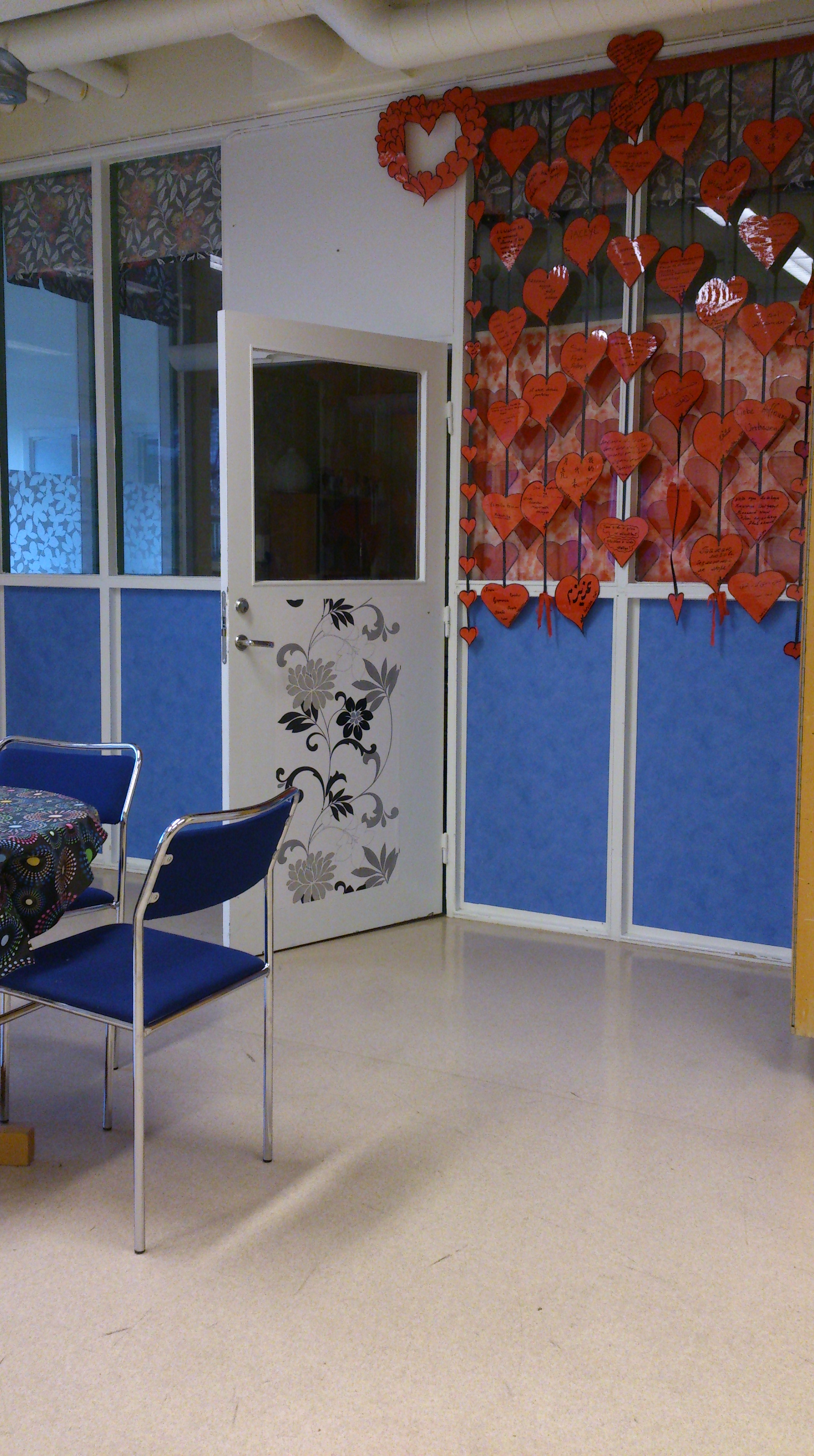
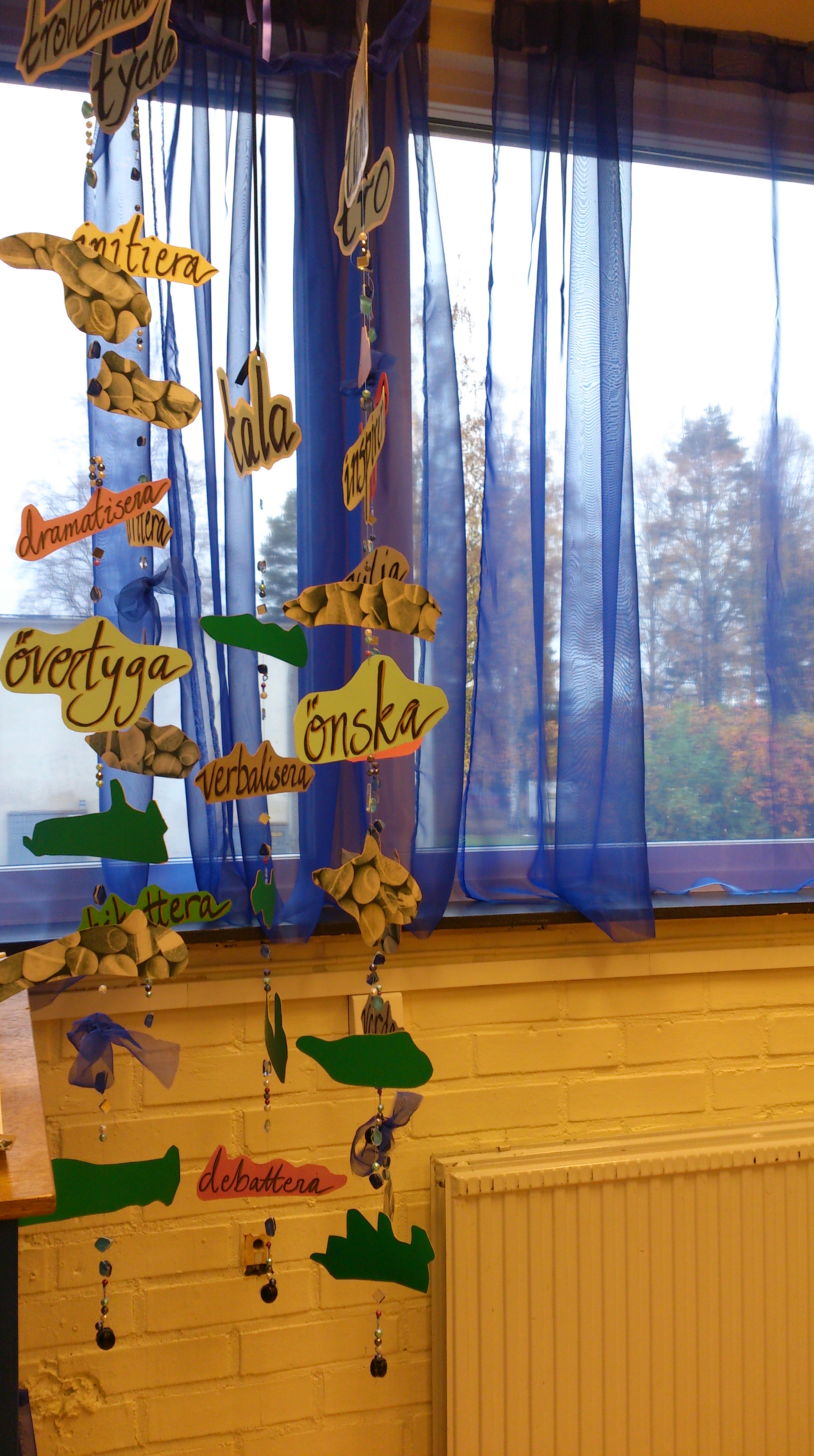
My classroom is not painted by me and it is not yellow either, but I have hanged The Blue Wallpaper myself and I have added a lot of blue accents, such as glass, fabric or decorations. Blue is my fave color and it also lead my thoughts to water or to a realxing feeling that makes me calm. In one of the corners of my room I have a waterdoor… In another corner are verbs connected to language use. The many hearts on the window to our pentry is decorated with thoughs or words on the theme LOVE. I think my students are important in many ways. I also find their background, culture and languages important. I think it is necessary for a classroom where languages are taught, that you actually can see that we speak different languages. All those languages are important. Knowing several languages is a true wisdom!

BLÅTT och GULT

 DSC_0016DSC_0017DSC_0015


The teacher I visited was teaching about weather expressions in Spanish when I was there and both the students and herself were happy… and yellow is the happy color that perfectly suits a classroom for Spanish lessons. A saying by an ”unknown” author that suits the yellow classroom very well:

Keep your face to the sunshine and you cannot see the shadow

The ninetyfirst åsic- To help students understand and find connections is what teaching’s all about!

For two weeks I have had the wonderful opportunity to be among students and teachers at #Pitman Middle School in #New Jersey, #USA. I have been monitoring instruction in many different classes and seen many very good examples of teaching. My main focus has been ESL-teaching and I have seen examples of that both in primary schools and in adult classes of different kinds. Some of the adult students were part of a program for parents and were taught in classes with students from many different countries. They were preparing for a test and if they’d pass the test that would help them qualify for being American citizens. Other adults I met learned language for their own good, so to speak. They had different private reasons for taking the course and were taught in a smaller group within a local college. In every one of these differents setting and with every single teacher I have noticed high quality and a good knowledge both in what an ESL student needs and also teaching and instruction in general. When in class, I can see that many of the teachers have the same idea as I have, i.e to teach through themes or concepts rather than details. Today, since it is Halloween here, I have noticed that younger kids in primary schools here learn about the local legend #The New Jersey Devil. According to the legend he was the thirteenth child of a worn out woman who didn’t want her child. She cursed him and said ”to the devil with him!” and since then he is haunting #the Pine Barrens in New Jersey. The story is told this day since this is his birthday.

All teachers and students seem very into the idea of Halloween, even if not all schools celebrate with costumes and dresses. One of the classrooms I visited today, a classroom where Spanish is the main subject, focused on the differences between Halloween and the Mexican tradition for Dia de las Muertas  (the Day of  the Dead). The American kids get a chance to comment on what is similar or different when they compare these two holidays. The teacher help them along the way and try to get them to precise what they mean. She asks questions like ”How do you mean?”  ”What would you have thought if a loved one came back to life?” The point for the teacher is to explain that the Mexican Holiday is not at all scary or horrific, but rather a nice way of remembering your loved ones who passed away. The teacher then connects to the American people’s connections to the date 9/11 and the kids all get a chance to share the stories their parents have told them about 9/11. The idea is to show the kids that by remembering and talking about sad or scary memories, those memories get a little easier to talk about each time. Then she wraps it all up by saying THAT is what the Mexicans do when they celebrate THEIR holiday. They stick to the nice memories of a person and cherish those memories in a more happy manner, although they are dressed or disguised into skeletons etc. I was very happy to get the chance to see this lovely explanation of what the different festivities are all about. To help students understand and find connections is what teaching’s all about! I have written in Swedish about the importance of this in my tenth åsic and in my seventyeighth åsic. Those of you who read Swedish are of course welcome to read and for my English readers I plan to translate my blogposts gradually when I find time to do so.

Thank You and Farewell #Pitman Middle School

The eightyeighth åsic- Kids vs Adults, a comparison shows that FAQ are very different

fragor.jpg (470×200)


Today I visited a few new classrooms where I haven’t been before. It was very interesting to again note that kids and adults do not ask the same kind of questions. Generally speaking I would say that kids like to know, for real, what it might be like to live in Sweden. They ask personal questions formed from their own point of view and seem happy to get an answer.

Some adults may have a real interest, too, BUT the interesting thing is that they tend to repeat each others questions. Check what adults have asked me the last week:

  1. Are you Irish?
  2. Is this your first time in the US?
  3. For how long will you be here?
  4. Have you visited other states in the USA?
  5. When does school start in Sweden?
  6. How many school days are there?
  7. What subjects do you teach?
  8. How many students are there in each class?
  9. What kind of grades do you use in Sweden?
  10. What American singer would be THE most famous, Elvis or Michael Jackson?

There have been a FEW more questions, but the above questions have tended to come back. Now look at the questions kids have asked:

  1. Do you celebrate Halloween?
  2. What cellphones brands do you have in Sweden?
  3. What clothes do you wear in Sweden?
  4. How far from China is Sweden?
  5. What does the Swedish national anthem sound like?
  6. What do the houses look like in Sweden?
  7. How old are your daughters?
  8. What music do you listen to in Sweden?
  9. What famous Americans are popular in Sweden?
  10. Are there IKEA:s all over Sweden?
  11. What sports do you do in Sweden?
  12. Do you eat the same food as we do?
  13. What kind of farms are there in Sweden?
  14. What do you grow in Sweden?
  15. What does the trees look like in Sweden?
  16. Does The Swedish House Mafia really come from Sweden?

Kids tend to want to know about things out of school more than the teachers do.Teachers tend to ask about school related topics. I find that most interesting. Another thing I find interesting is the way no lesson where I have been involved has been at all like the other. I have asked the kids what they wanted to know and that has lead to lessons that differed very much from each other. Being in a situation where I can choose what to share or not from what the students like to know, has thus been just like I prefer to work, i.e in a group oriented manner. I will miss this school and all the kids next week when I go home. They are all very open and welcoming and I have a great time learning more about this NJ school.

The eightysixth åsic- Höstlöv, höstlov, hostlov, Fall Break!

foto-canvas-canvastavlor-24.jpg (600×375)barn_host.JPG (510×315)hosta-300x252_150299504.jpg (300×252)


Four different spellings means four different things, of course they do, but let’s take a closer look at it!

  1. höstlöv= autumn leaves→ when days get colder and leaves change colours from green into more colourful yellow, orange or red
  2. höstlov=fall break→ when Swedish school kids have a week off while teachers either go to conventions or work with their local projects, or get a chance to get some busy time back.
  3. hostlov= a coughing  ”break” meaning that the planned ”höstlov” would be a week when you had to stay in bed because of coughing… 😦
  4. Fall break=höstlov
  5. Ö→In Swedish we have three different letters that you can’t find in English. They are å, ä and ö.

If I would use a computer keyboard here, in the US, I would need to find some solution to writing the Swedish letters, which would cause problems since I’m not that much of a computer person. Instead I tend to write ”Swedish” with the computers I find here, but replacing the å, ä and ö with a, a and o. There! See??? Already we have a chance to mix them up, since å and ä are not the same as a and a… So how would one tell whether the intention is to write å or ä? Knowing what reading is about, one might pretend to be Sherlock Holmes and try to find out by checking the meaning of the words around…or perhaps being Swedish might be of help…? Check these two chunks of Swedish, but spelled without the å or ä:

  1. Ett far kan braka.
  2. Titta en bat!

Let’s say you don’t know Swedish at all… Then you would think it’s something wrong with the grammar in the first sentence, I guess… or you would just assume that this person has missed out a word of maybe is dyslectic.

The first sentence may mean several things in Swedish, but knowing Swedish properly means knowing whether you would use ”en” or ”ett” (comparable to the use of ”a” or ”an” in English). A Swedish person would know that if ”far” in the first sentence actually is correct (meaning ”father”) then there has to be ”en” rather than ”ett” if written with correct use of grammar. Suppose this person assume it is a father then… On to the problem with ”braka”… That word is a verb and you would mainly use it to describe what happens if a construction of some sort break apart, such as if a tree falls over a shed in your garden, you would say that the tree fell over the shed: ”skjulet brakade sönder”. The use of ”braka” might also suggest the sound of something, not necessarily something nice… Suppose you lunch was beans… After a while you really have to fart… If that happens and you can hear a sound, you would in colloquial or dialectal Swedish say ”han brakade” meaning ”he farted”. Then, what happens with the first sentence is that you have different options now, right? Either the meaning is ”en far kan braka” meaning ”a father can fart” or we need to doublecheck the meaning of the word braka… Is there any chance for that word being spelled with either å or ä??? Oh… as a matter of fact, both would be possible to use… ”En far kan bråka” means ”a father can be messing/fighting”… ”En far kan bräka” means that the father makes the sound of a sheep. Would a father to that? Yes, maybe if he plays with his kids or something, but it is more likely that we didn’t guess right when we picked either å or ä here… So then… What next??? I suggest for us to go back to the noun… ett far… We already know that ett far is not how we would say in Swedish. We would say ”en far” if it HAD meant father…but suppose it doesn’t? ”Ett får”= a sheep, YES!!! A sheep can bleat= ”ett får kan bräka”. Guess what??? This is what you and I do in a matter of SECONDS when we read a text!!! I think that’s amazing! Don’t you?

Let’s repeat the concept…by checking the second sentence!

”Titta” means ”look”… ”en” means ”a”… bat is a word in English, but not in Swedish. A Swedish speaking person has two options here. One is to assume that the word ”bat” means the currency they use in Thailand and then also assume that the person who wrote it has missed an ”h”  in ”baht”, but more likely is for the person to read between the lines and understand that nobody would comment on Thai currency in that way and rather suggest that the ”bat” has to be spelled with either ”å” or ”ä”. When picking one of these this time it’s easy! Why is that? Well, there IS no such word as ”bät” in Swedish, so problem is solved with ”båt” meaning ”boat” and the sentence will be ”Look, a boat!”

By reading between the lines, one can get a lot of language learning, don’t you think?

The eightyfifth åsic- ”HALF&HALF” or Completely Wrong!

I don’t drink regular milk since I have a lactose intolerance. For my visit here in the US I had to make sure there would be something to replace my usual products with and today it was time to fill the fridge again. After we got back home I wanted to comment on ”milk” in general and since ”my” family here drink something that they call ”HALF&HALF” (a mixture of milk and cream as I understand it). I wanted to know what that was. So I asked…and they both laughed. I didn’t quite get what’s wrong, but i found out soon enough. They repeated what I said and I still couldn’t get it. I said it again, ”HALF&HALF”. Then they said: ”We don’t say that!” I couldn’t understand, because on the box it clearly says ”HALF&HALF” and that was what I said, over and over again. Finally I ASKED them what THEY said then… They said, too: ”HALF&HALF”, but their sound of the ”A” was as far from mine as the distance from here to Buckingham Palace! We all laughed and made fun of the different pronunciations and what would happen if you loudly would shout out in the store HERE, but with my pronunciation: ”Dear, please go and get some ”HALF&HALF”!!

My reflection is that if my friends hadn’t pointed out that we in fact used different pronunciations for the expression, I wouldn’t have noticed. I know that may seem weird to some of you, but different accents don’t ”bother” me anymore and I know my own accent is a strange mixture of different accents. A few people in school last week suggested I’ve got an Irish accent, which I enjoyed, since I have never been there… 😀