One hundred and sixth åsic- What’s your name? Let’s make a rock carving!

Many years ago I went on an excursion in the village Nyberget, Stora Skedvi, where my mum grew up. We climbed a mountain just outside the village and the view was magnificent. The striking view was however not the purpose of this excursion, but instead we had all come to see for ourselves how young people from way back when had found a lot more important things to do on Midsummer’s Eve than to sing ”Små grodorna” and dance round the May Pole…
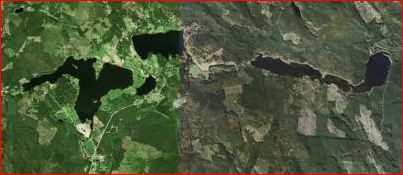
Lövåsberget med omnejd_Stora Skedvi

The lecturer, Stig Welinder, a well-known archeologist who at that time lived in the village, shared both details about many of the couples and facts found in the many church archives from the actual time. In Sweden it is possible to track our ancestors several hundred years back in time and this was also what the archeologist had done, in detail. He could tell stories of families with happy or sad moments in their lives, all facts verified and found in public archives where anyone could have found pretty much the same information if only we had spent that time. Many of the young couples in the local area had climbed this very mountain on Midsummer’s Eve to enjoy the sunset together.  To remember the day, they carved their names in the rocks on top of the mountain and also planned for a future life together. The place was well-known in the nearby villages as ”Skrivarhällen”(Welinder, 1992) and not just the teenagers from one of the villages climbed the mountain, but also those who lived on the other side of the mountain, a bit further away.

The rock carvings can still be found, if you first climb the mountain! 😀

Among other things that Welinder shared with us in his lecture, was the nature of names in Dalarna at the time when the rock carvings were made.  But there were just a few different names that seemed to be popular, and a few names were just the same, so in order to know who was who, you needed to add the name of the farm, or place, such as Petter Danielson, On the Hill. His son would be named after his father, Daniel Pettersson + On the Hill, and his son in turn, would most likely be called Petter Danielsson+ On the Hill… For women, the use of daughter would be used instead of son.

I would, for instance, have had the family name Dalkesdotter, since I am the daughter of Dalke. My brother would acoordingly have been called Dalkesson. During the 23 years I have been teaching I have noticed the change in naming. When I graduated in 1991, many of my first students had names that have been used in our country for generations. Boys names like Daniel, Peter, Mikael, Anders and girls names like Anna, Maria, Kristina, Helena, Ylva etc. But after a few years of teaching I noticed that many of the boys now rather had names like, Kevin, Justin, Jim, Tim, Tom and girls had names like Natalie, Felicia, Caroline, Nellie etc. Nowadays we find a lot of different names, a variation that can be connected to our complex world with input from not just the local area, but from other parts of the world.
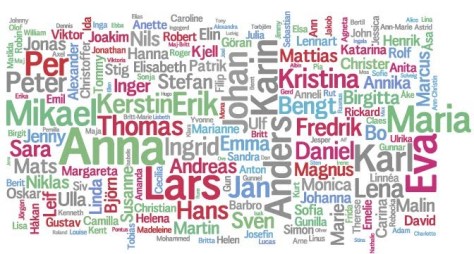
namnbild.jpg (672×361)

My own name, Åsa, is from the time before Sweden was Christened and means ”goddess”. Very few little Åsa’s are to be found nowadays, but instead some of the names that I would connect to old relatives are coming up as new favourite names for kids. It’s funny how one sometimes hear parents call for their little ones and you expect a person in their seventies to approach behind a tree in the park, but instead a little toddler, called Bosse or Leif, will meet his Mom with a lovely smile!

toddlerRoundup-14.jpg (600×503)

My friend the archeologist from the mountain top is a very good example of being modern at the same time as he cherishes the value of how our ancestors chose to live their lives. What footprints or fingerprints will our generation leave? No mountains will be filled with names, but maybe we will share something else that is just as interesting and important? Let’s hope so!

Welinder, S (1992) on Skrivarhällen i southern Dalarna, Bergslagen, Sweden

A mini åsic- Rain, rain go away, come again another day…

I remember a long time ago, when I was sitting by the campfire together with a lot of friends. It was raining and we were still happy since the fire kept us warm. We sang a lot of nice and warming songs and among them was a canadian song that one of the participants knew from her time in Canada. It was said to be of indian origin. Of course I don’t know whether that’s true or not, since it’s so long ago, but the song was like a mantra, a short melody one would repeat over and over in order to scare the rain off… The very simple lyrics is still there in my head every rainy day, such as today: ”Rain, rain, go away, come again another day!”

I’ve been writing about rain here today, but most of the memories I shared was very Swedish and also very connected to typical Swedish things to do during summer. I do however want to contribute with two memories from abroad. One is from Britain and one is from the US.

The British memory is not just ”a memory” but rather a long long long MONTH… I visited Britain during fall the yearof  2000. I was pregnant with my second daughter and a bit nauseous because of that. On top of my feeling of nausea, I stayed in a very strange Bed & Breakfast where the landlady was a true pain… She forced me and my friend Eva to stay outdoors for certain hours and also didn’t offer any help to dry our clothes. Now… who cares? If it had been a lovely New England fall with colourful maples and crisp air and sunshine, I wouldn’t care anyway… Now, however, it was for sure OLD England with all that it takes…so it poured for a month… At home, before I left, I had bought a strange kind of rain cap, a really cheap one, since I didn’t anticipate any rain… I tend to think that if I plan for sunshine, there WILL be sunshine… Obviously my plans aren’t always heard…

The whole month I didn’t get my clothes completely dry. Why? Because the landlady didn’t think it was cold enough to put any heat on yet… I didn’t bring my wellingtons from Sweden, but rather walked around in very wet sneakers. My feet were a complete ”wrinkle” when I finally returned to Sweden. I understand why Britons tend to joke about the weather. It may be their only chance to cope. I’m happy I live in a country where fall season MIGHT conclude some SUNSHINE, too…

The US memory is from the time to depart from my dear friends the Groffs in the summer of 2004. At the time when we decided to go to the airport in Philly the sky opened and I bet ALL that summer’s rain fell on the road where we drove… My flight was delayed with a couple of hours and I remember I was a little bit scared of flying. Being in the airport for two extra hours wasn’t that nice, but luckily the flight went well and I got back home to the sunny country of Sweden again. We hardly ever have any rain, nudge,nudge… Today is an exception…

Rain, rain go away, come again another day…

Sjuttonde åseriet- A World of Language Learning Starts in Your Computer

I’d like to share with you how learning can become interesting to young students if focus on learning derives from questions raised by the students rather than the teacher. I was teaching a mixed group of students in grade four and five in the Swedish compulsory school system. The students all had very few contacts with native speakers of English or with students from other countries. I wanted them to improve both their written an oral English and thought of different ways. It was in the middle of the annual summer vacation and as usual I spent time thinking of the coming school year. Isn’t that typical for a teacher? I know I’m not the only teacher who spends time planning for future teaching while their off of school.
Anyway, I thought of the idea of getting some kind of pen-pal for each and every one of my students. At this time I had just got my first personal computer through work and I wasn’t very familiar with how to use internet as a resource. I was therefore searching for different websites in order to find addresses to PEN-pals. It wasn’t until I came across the website http://www.epals.com with the very new word #epals, that I realized that PEN-pals were completely outdated! I was thinking like a dinosaur! Briefly, Epals is a website where teachers or students or for that matter teachers AND students can get in touch with each other in order to collaborate in different projects. It doesn’t have to be international projects, but in my case it was.
From the start I didn’t plan to collaborate at all with any American teachers. I was focused on the UK, since I was going to the UK in September in 2000. I spent a couple of hours reading different profiles in the epals website and then I wrote my own profile. Already while I was browsing the site, I got a few mails in my inbox. There were two of them from American teachers and one of them was from a British teacher. They all seemed very nice, but since I was in a hurry to get my project going, I wrote to the British teacher, telling him about my plans to go to the UK and I also fired off my question about the two of us meeting each other to plan our future collaboration with our students. I wrote “Since I come to the UK in September, I hope we can meet and plan for our mutual project!” Then, since I was in a hurry and also because I know that teachers don’t like to spend time doing the wrong things, I wrote back to the two other teachers politely telling them that unfortunately I had already found a teacher in Britain whom I wanted to collaborate with and thus I didn’t need to write to them…
The “British” teacher replied to my email saying something like “It’s not that I don’t WANT to meet you, but how exactly did you think we could meet if you go to the UK and I live in New Jersey?”
Anyone who gets an email with that comment could have given up, but I’m not that kind of person. I wrote back. The “British” teacher wasn’t at all British and the REAL British teacher, whom I mistaken for being American, was of course already lost and gone, so what options did I have??? I started off brushing up my own English, by writing back and forth to this particular American teacher, who seemed to be a nice person already from the start. He was a teacher in a class in the same age span as my students, so after a few weeks of planning we started off writing emails between the two different schools.
At first, we instructed our own classes to write more general letters about themselves and share photos and details about the school system or what the school looked like. But gradually as the students got to know each other a little better, they started to ask their own questions and compared the learning situations in Sweden and New Jersey. My students, who were used to several breaks during school days, were shocked to notice that the students in the American school had fewer breaks and also lacked a nice lawn and a playing-ground at school. Outside the American school was instead a parking lot.
There were a lot of similar topics that gave students in both ends of our mutual collaboration a chance to challenge their language skills. In the American end students had a more cultural based viewpoint to our project, whereas in Sweden the focus was mainly on language and how to express oneself. One thing lead to another and the American teacher and I also visited each other’s schools and got the opportunity to see through teaching what it was like to teach in a completely different school setting than the one we were used to, respectively. I remember from MY teaching during one single day in the American school, that it was weird to be addressed with my Mrs Olenius. I also found it interesting to interact with the student in MY way, rather out spoken and joking, and notice how a few of the American TEACHERS frowned. It seemed to me as if they were taking their ROLE as teachers much more seriously than I do, which was interesting to note.
Later, my American friend visited me and my class in Sweden. He had brought with him a few interesting lessons to teach and one of them was in Physics, where he wanted to show the students how an American Hurricane builds up, by using two large bottles that he quickly moved in order to make it seem like a hurricane within the bottles. An interesting thing with his experiment is the obvious difference between the ways we would do such and experiment and the way he did. He ended up getting eager students around him who wanted to do the experiment themselves, not just look at him doing it. In Sweden I’d say most teachers would give their students the opportunity to try out such an experiment by themselves. Another thing the American teacher probably noticed is that his usual reference to the famous Wizard of Oz didn’t work in Sweden. Why not?
A Swedish student in grade five generally wouldn’t know what kind of movie that is.
I’m happy to say that this American teacher and I have been friends for a long time now and thanks to him, I have learnt a lot about America that is more positive than I could ever imagine. Maybe it was meant to be that I mixed the American teacher with the British?